evolution

Evolution is defined as the process of growth and development or the theory that organisms have grown and developed from past organisms.

(noun)

  1. An example of evolution is how cell phones have changed over time.
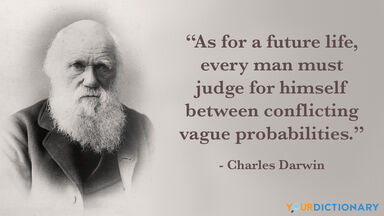
  2. An example of evolution is the theory started by Charles Darwin that theorizes about how humans came to be in their present form.

YourDictionary definition and usage example. Copyright © 2013 by LoveToKnow Corp.

See evolution in Webster's New World College Dictionary

noun

  1. an unfolding, opening out, or working out; process of development, as from a simple to a complex form, or of gradual, progressive change, as in a social and economic structure
  2. a result or product of this; thing evolved
    1. a movement that is part of a series or pattern
    2. a pattern produced, or seemingly produced, by such a series of movements: the evolutions of a fancy skater
  3. a setting free or giving off, as of gas in a chemical reaction
  4. Biol.
    1. the development of a species, organism, or organ from its original or primitive state to its present or specialized state; phylogeny or ontogeny
    2. Darwinian theory
  5. Math. the extracting of a root of a given number
  6. Origin: Fr évolution

    Mil. any of various movements or maneuvers by which troops, ships, etc. change formation

Origin: L evolutio, an unrolling or opening < evolutus, pp. of evolvere: see evolve

Related Forms:

See evolution in American Heritage Dictionary 4

noun
  1. A gradual process in which something changes into a different and usually more complex or better form. See Synonyms at development.
  2. a. The process of developing.
    b. Gradual development.
  3. Biology
    a. Change in the genetic composition of a population during successive generations, as a result of natural selection acting on the genetic variation among individuals, and resulting in the development of new species.
    b. The historical development of a related group of organisms; phylogeny.
  4. A movement that is part of a set of ordered movements.
  5. Mathematics The extraction of a root of a quantity.

Origin:

Origin: Latin ēvolūtiō, ēvolūtiōn-

Origin: , from ēvolūtus

Origin: , past participle of ēvolvere, to unroll; see evolve

.

Related Forms:

  • evˌo·luˈtion·al, evˌo·luˈtion·arˌy (-shə-nĕrˌē) adjective
  • evˌo·luˈtion·arˌi·ly adverb

See evolution in Ologies

Evolution

See also biology; change; growth; improvement.

Darwinism

the theory of evolution by natural selection of those species best adapted to survive the struggle for existence. —Darwinian, n., ad).

evolutionism

a principle or theory of evolution. —evolutionist, n., adj.

Lamarckism

the theory of organic evolution advanced by the French naturalist Lamarck that characteristics acquired by habit, diseases, or adaptations to change in environment may be inherited. —Lamarckian, n., adj.

Neo-Darwinism

the theory that maintains natural selection to be the major factor in plant and animal evolution and denies the possibility of inheriting acquired characteristics. —Neo-Darwinist, n., adj. —Neo-Darwinian, n., adj.

Neo-Lamarckism

a modern theory based on Lamarckism that states that acquired characteristics are inherited. —Neo-Lamarckian, n., adj.

orthogenesis

progressive evolution, leading to the development of a new form, as can be seen through successive generations. See also society. —orthogenetic, adj.

pangenesis

the theory advanced by Darwin, now rejected, that each part of the body is represented in each cell by gemmules, which are the basic units of hereditary transmission. —pangenetic, adj.

phylogeny

the history of the development of a plant, animal, or racial type. —phylogenist, n. —phylogenetic, adj.

primordialism

a devotion to the conditions which existed at the beginning of creation.

transformism

the ability of one species to change into another. —transformist, n.

tychism

1. the theory that chance is involved in evolution and that variation within a species is accidental.

2. the belief that chance rather than mere determinism operates in the cosmos. Cf. uniformitarianism.

uniformitarianism

1. Philosophy. a doctrine that the universe is governed only by rigid, unexceptionable law.

2. Geology. the concept that current geological processes explain all past geological occurrences. —uniformitarian, n., adj.

Learn more about evolution

Related Articles

link/cite print suggestion box