empire

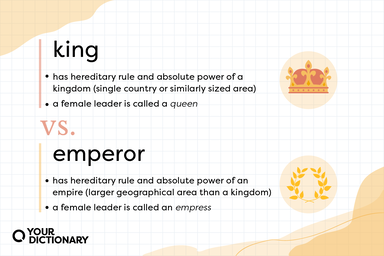
An empire is defined as a political unit or territory or large geographic area under a unified or supreme authority, often an emperor or empress.

(noun)

An example of an empire is the area over which Alexander the Great ruled.

The definition of empire is something that relates to or is characteristic of Napoleon's French empire.

(adjective)

An example of empire is an empire dress, a dress with a waistline gathered just under the breasts with a long flowing skirt.

YourDictionary definition and usage example. Copyright © 2013 by LoveToKnow Corp.

See empire in Webster's New World College Dictionary

noun

  1. supreme rule; absolute power or authority; dominion
    1. government by an emperor or empress
    2. the period during which such government prevails
    1. a group of states or territories under the sovereign power of an emperor or empress
    2. a state uniting many territories and peoples under a single sovereign power
  2. an extensive social or economic organization under the control of a single person, family, or corporation

Origin: ME & OFr < L imperium < imperare: see emperor

adjective

of or characteristic of the first French Empire (1804-15) under Napoleon; specif.,
  1. designating a style of furniture of this period, characterized by massiveness, bronze ornamentation, and motifs of ancient Greece, Rome, and Egypt
  2. designating a gown in the style of the period, with a short waist, décolleté bodice, flowing skirt, and short, puffed sleeves

See empire in American Heritage Dictionary 4

noun
  1. a. A political unit having an extensive territory or comprising a number of territories or nations and ruled by a single supreme authority.
    b. The territory included in such a unit.
  2. An extensive enterprise under a unified authority: a publishing empire.
  3. Imperial or imperialistic sovereignty, domination, or control: “There is a growing sense that the course of empire is shifting toward the . . . Asians” (James Traub).

Origin:

Origin: Middle English

Origin: , from Old French

Origin: , from Latin imperium

Origin: , from imperāre, to command; see emperor

.

adjective
Of, relating to, or characteristic of a neoclassic style, as in clothing or the decorative arts, prevalent in France during the first part of the 19th century.

Origin:

Origin: After the First Empire of France (1804-1815)

.

noun
A variety of apple having medium fruit with waxy, dark red skin and white flesh.

Origin:

Origin: After the Empire State, nickname for the state of New York, where it was developed

.

Learn more about empire

empire

link/cite print suggestion box