connotation Hear it!

connotation Definition

con·no·ta·tion (kän′ə tās̸hən)

noun

  1. the act or process of connoting
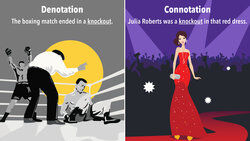
  2. something connoted; idea or notion suggested by or associated with a word, phrase, etc. in addition to its explicit meaning, or denotation “politician” has different connotations from “statesman”
  3. Logic the properties possessed by all the objects in a term's extension; intension

Etymology: ME connotacion < ML connotatio

connotation Related Forms
con·no·ta′·tive (känə tāt′iv, kə nōtə tiv) adjective or con′·no·ta·tion·al con·no·ta′·tively adverb
connotation Synonyms

connotation

n.

connotation Usage Examples

Converse of object

  • carry: Why does the term carry such negative connotations for me?
  • acquire: Increasingly it has acquired a negative connotation, implying excessive demand or pressure.
  • attach: Connotations attached of the term also vary significantly between and within different countries.
  • avoid: I would say principles rather than rules, to avoid the connotation of correctness.
  • have: ABC also has connotations of grading degrees of failure.
  • associate: Ballroom Unfortunately many may be put off by the connotations associated with ballroom dancing, particularly male potentials!

Adjective modifier

  • pejorative: Bach argues against the pejorative connotations of " optical illusion " , which suggests they are visual malfunctions.
  • negative: No negative connotation was intended by the label ' short ' .
  • derogatory: Why should Muhammad use a name with such derogatory connotations, instead of his original name which has no such " historical " baggage.
  • sinister: The history of the authority shows it to be incapable of policing cloning, which could have sinister connotations " .
  • unfortunate: The word " selection " has unfortunate connotations; " choice " would be better.
  • sexual: Most often this word seems to have sexual connotations.

Noun used with modifier

  • pagan: The only exceptions were people who had a name with unpleasant or pagan connotations.
  • class: Thirty years ago smoking had no clear social class connotations.

Possessives

  • word: For lack of an exact equivalent, it may be termed soul, despite that word's other connotations.

Preposition: in

  • context: In Trinitarian understanding the word God can have different connotations in different contexts.

Preposition: of

  • word: A learner who fails to understand the connotation of a word will probably fail to get the message of the text.
  • term: There are clearly enough connotations of the terms for them to be useful.
  • violence: They did not wish their visual voice in that instance to be one that carried connotations of violence.