conjunction

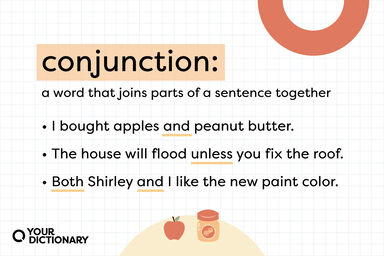
The definition of a conjunction is the joining together of elements and it is a word that connects sentences, phrases or clauses.

(noun)

  1. An example of conjunction is classmates coming together to solve a math problem
  2. An example of conjunction is the word "and."

YourDictionary definition and usage example. Copyright © 2013 by LoveToKnow Corp.

See conjunction in Webster's New World College Dictionary

noun

  1. a joining together or being joined together; union; association; combination
  2. an occurring together; coincidence: the conjunction of events
  3. Astrol., Astron. the condition of two or more celestial bodies, esp. a planet with the sun, located along the same celestial longitude when observed from the earth
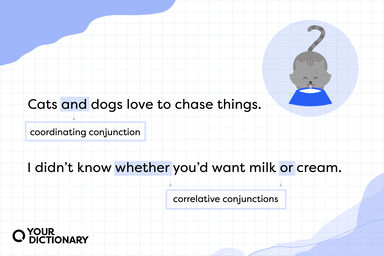
  4. Gram. an uninflected word used to connect words, phrases, clauses, or sentences; connective: conjunctions may be coordinating (Ex.: and, but, or), subordinating (Ex.: if, when, as, because, though), or correlative (Ex.: either . . . or, both . . . and)

Origin: ME conjunccion < OFr conjunction < L conjunctio < pp. of conjungere: see conjoin

Related Forms:

See conjunction in American Heritage Dictionary 4

noun
  1. a. The act of joining.
    b. The state of being joined.
  2. A joint or simultaneous occurrence; concurrence: the conjunction of historical and economic forces that created a depression.
  3. One resulting from or embodying a union; a combination: “He is, in fact, a remarkable conjunction of talents” (Jerry Adler).
  4. Abbr. conj. Grammar
    a. The part of speech that serves to connect words, phrases, clauses, or sentences.
    b. Any of the words belonging to this part of speech, such as and, but, as, and because.
  5. Astronomy The position of two celestial bodies on the celestial sphere when they have the same celestial longitude.
  6. Logic
    a. A compound proposition that has components joined by the word and or its symbol and is true only if both or all the components are true.
    b. The relationship between the components of a conjunction.

Origin:

Origin: Middle English coniunccioun

Origin: , from Old French conjunction, conjuncion

Origin: , from Latin coniūnctiō, coniūnctiōn-, a joining, conjunction (in grammatical sense, translation of Greek sundesmos, binding together, conjunction)

Origin: , from coniūnctus

Origin: , past participle of coniungere, to join; see conjoin

.

Related Forms:

  • con·juncˈtion·al adjective
  • con·juncˈtion·al·ly adverb

Learn more about conjunction

Related Articles

link/cite print suggestion box