astronomy

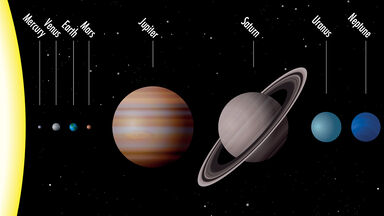
The definition of astronomy is the scientific study of matter outside of the atmosphere of the Earth including stars, planets and what they are made of and how they move.

(noun)

Someone who examines moon rocks to determine their composition is an example of someone who engages in astronomy.

YourDictionary definition and usage example. Copyright © 2013 by LoveToKnow Corp.

See astronomy in Webster's New World College Dictionary

noun

  1. the science of the universe in which the stars, planets, etc. are studied, including their origins, evolution, composition, motions, relative positions, sizes, etc.
  2. pl. astronomies a book or treatise on this

Origin: ME & OFr astronomie < L astronomia < Gr < astron, star + nomos, law: see -nomy

See astronomy in American Heritage Dictionary 4

noun pl. as·tron·o·mies
  1. The scientific study of matter in outer space, especially the positions, dimensions, distribution, motion, composition, energy, and evolution of celestial bodies and phenomena.
  2. A system of knowledge or beliefs about celestial phenomena: the various astronomies of ancient civilizations.

Origin:

Origin: Middle English astronomie

Origin: , from Old French

Origin: , from Latin astronomia

Origin: , from Greek astronomiā

Origin: : astro-, astro-

Origin: + -nomiā, -nomy

.

See astronomy in Ologies

Astronomy

See also cosmology; mars; meteorites; moon; planets; sun.

aerolithology

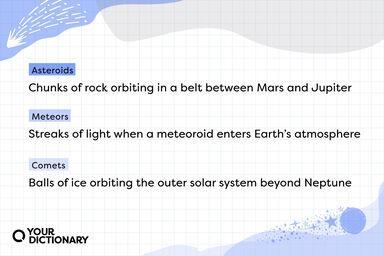
the branch of astronomy that studies meteors.

aerolitics

the branch of astronomy that studies aerolites, or stony meteors.

albedo

the ratio between the light reflected from a surface and the total light falling upon that surface, as the albedo of the moon.

aphelion

the point in the orbit of a heavenly body where it is farthest from the sun. Cf. perihelion.

apolune

in an orbit around a moon, the point furthest from the moon. Cf. perilune.

areology

the astronomical studies of the planet Mars. —areologist, n.areologic, areological, adj.

asterism

Rare. a constellation or small group of unrelated stars. —asterismal, adj.

astrogation

the art of navigating in space. Cf. astronavigation.astrogator, n.

astrogeny, astrogony

the theory of the evolution of heavenly bodies.

astrogeology

a geological specialty that studies celestial bodies.

astrognosy

the branch of astronomy that studies the fixed stars.

astrography

a scientific analysis and mapping of the stars and planets. —astrographic, adj.

astrolatry

the worship of the heavenly bodies. Also called Sabaism. — astrolater, n.

astromancy

1. a form of divination involving studying the stars.

2. Rare. astrology. Also called sideromancy.astromancer, n.astromantic, adj.

astrometry

the branch of astronomy that studies the dimensions of heavenly bodies, especially the measurements made to determine the positions and orbits of various stars. —astrometric, astrometrical, adj.

astronautics

the science of space travel, concerned with both the construction and the operation of vehicles that travel through interplanetary or interstellar space. Also called cosmonautics. —astronautic, astronautical, adj.astronaut, n.

astronavigation

a type of navigation involving observations of the apparent positions of heavenly bodies. Also called celestial navigation, celo-navigation. —astronavigator, n.

astronomy

the science that studies the stars and other features of the material universe beyond the earth’s atmosphere. —astronomer, n. —astronomical, adj.

astrophile

a person strongly attracted to knowledge about the stars. —astrophilic, adj.

astrophotography

a form of photography used to record astronomical phenomena.

astrophysics

the branch of astronomy concerned with the origin, and the chemical and physical nature of heavenly bodies. —astrophysicist, n.

celestial navigation

astronavigation. Also called celo-navigation.

chromatoscopy

the study of stars through a telescope in which the star appears as a ring of light, in order to observe the star’s scintillation. —chromatoscope, n.

Copernicanism

the fundamental theoretical basis of modern astronomy, first demonstrated in the early 16th century by Copernicus, who showed that the earth and the other planets orbit around the sun. Cf. Ptolemaism.

cosmolabe

Obsolete, an instrument, like an astrolabe, used for astronomical observations.

cosmonautics

astronautics. —cosmonaut. n.cosmonautical, adj.

heliodon

an instrument used in astronomy to show the apparent movement of the sun.

heliometer

an instrument originally designed for measuring the sun’s diameter, now used for measuring the angular distance between stars.

heliometry

the practice of measuring the angular distance between stars by means of a heliometer. —heliometric, heliometrical, adj.

interlunation

the period between the old moon and the new when the moon is invisible each month. —interlunar, adj.

meridian

an imaginary great circle in the sphere of the heavens, passing through the poles and the zenith and nadir of any point and intersecting the equator at right angles. See also 178. GEOGRAPHY. —meridian, meridional, adj.

metagalaxy

the entire system of galaxies, including the Milky Way. —metagalactic, adj.

nutation

the periodic oscillation that can be observed in the precession of the earth’s axis and the precession of the equinoxes. See also 133. EARTH. — nutational, adj.

obliquity

the inclination of the earth’s equator or the angle between the plane of the earth’s orbit and the plane of the equator (23°27’). Also called obliquity of the ecliptic. See also 133. EARTH. —obliquitous, adj.

occultation

the process of one heavenly body disappearing behind another as viewed by an observer.

paraselene

a false moon, in reality a bright spot or a luminous ring surrounding the moon.

perihelion

the point in the orbit of a heavenly body where it is nearest the sun. Also spelled perihelium. Cf. aphelion.

perihelium

perihelion.

perilune

in orbit around a moon, the point nearest the moon. Cf. apolune.

phantasmatography

Rare. a work or treatise on astronomy or celestial bodies.

planetarium

1. a representation of the planetary system, particularly one in which the movements of the planets are simulated by projectors.

2. a room or building housing such an apparatus.

planetology

the branch of astronomy that studies the planets. —planetologist, n. — planetologic, planetological, adj.

planisphere

a map showing half or more of the sphere of the heavens, indicating which part is visible at what hour from a given location. —planispheric, planispherical, adj.

Ptolemaism

the complicated demonstration of Ptolemy, 2nd-century geographer and astronomer, that the earth is the fixed center of the universe around which the sun and the other planets revolve; now discredited. Cf. Copemicanism.

Ptolemaist

a supporter of the Ptolemaic explanation of planetary motions.

radioastronomy

the branch of astronomy that studies radio frequencies emitted by the sun, planets, and other celestial bodies.

Sabaism

astrolatry.

Sabianism, Sabaeanism, Sabeanism

the religion of the Sabians, a group sometimes associated with worship of the sun, moon, and stars. See also religion.

schematism

the combination or configuration of the aspects of the planets and other heavenly bodies.

selenography

the scientific analysis and mapping of the moon’s physical features. —selenographer, selenographist, n.selenographic, selenographical, adj.

selenology

the branch of astronomy that studies the moon. —selenologist, n. —selenologic, selenological, adj.

sideromancy

a form of divination involving observations of the stars. Also called astromancy. —sideromancer, n.sideromantic, adj.

siderophobia

an abnormal fear of the stars.

uranianism

Obsolete, astronomy.

uranography

the branch of astronomy that deals with the description of the heavens by constructing maps and charts, especially of the fixed stars. Also called uranology. —uranographer, uranographist, n. —uranographic, uranographical, adj.

uranology

1. a written description of the heavens and celestial bodies.

2. another term for astronomy.

uranometry

1. a treatise recording the positions and magnitudes of heavenly bodies.

2. the science of measuring the real or apparent distances of heavenly bodies from Earth. —uranometrical, adj.

Learn more about astronomy

Related Articles

link/cite print suggestion box