speech

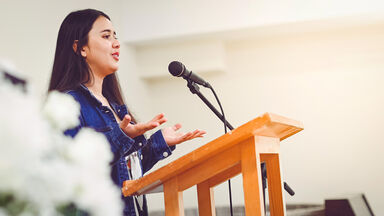
Speech is communication through talking or a talk given to an audience.

(noun)

  1. An example of speech is a conversation between two people.
  2. An example of speech is the presidential address.

YourDictionary definition and usage example. Copyright © 2013 by LoveToKnow Corp.

See speech in Webster's New World College Dictionary

noun

  1. the act of speaking; expression or communication of thoughts and feelings by spoken words
  2. the power or ability to speak
  3. the manner of speaking: her lisping speech
  4. that which is spoken; utterance, remark, statement, talk, conversation, etc.
  5. a talk or address given to an audience
  6. the language used by a certain group of people; dialect or tongue
  7. the study of the theory and practice of oral expression and communication
  8. Archaic rumor; report

Origin: ME speche < OE spæc, spræc < base of sprecan, to speak: see speak

See speech in American Heritage Dictionary 4

noun
  1. a. The faculty or act of speaking.
    b. The faculty or act of expressing or describing thoughts, feelings, or perceptions by the articulation of words.
  2. Something spoken; an utterance.
  3. Vocal communication; conversation.
  4. a. A talk or public address: “The best impromptu speeches are the ones written well in advance” (Ruth Gordon).
    b. A printed copy of such an address.
  5. One's habitual manner or style of speaking.
  6. The language or dialect of a nation or region: American speech.
  7. The sounding of a musical instrument.
  8. The study of oral communication, speech sounds, and vocal physiology.
  9. Archaic Rumor.

Origin:

Origin: Middle English speche

Origin: , from Old English sprǣc, spǣc

.

See speech in Ologies

Speech

See also language; pronunciation; rhetoric and rhetorical devices; sound.

acyrology

1. an incorrectness in diction.

2. cacology. —acyrological, adj.

alogia

Medicine. an inability to speak, especially as the result of a brain lesion.

aphasia

Pathology. an impairment or loss of the faculty of understanding or using spoken or written language. — aphasiac, n. —aphasic, n., adj.

aphonia

loss of the power of speech; dumbness. — aphonic, —apho-nous, adj.

aphrasia

loss or absence of the power of speech.

biloquism

the ability to speak in two distinct voices. —biloquist, n.

cacology

1. a defectively produced speech.

2. socially unacceptable enunciation.

3. nonconformist pronunciation.

deafmutism

the condition of lacking both hearing and speech. Also called surdomutism. —deafmute, n.

dyslogia

Pathology. an inability to express ideas or reasoning in speech because of a mental disorder.

dysphasia

an impaired state of the power of speech or of the ability to comprehend language, caused by injury to the brain.

dysphemia

any neurotic disorder of speech; stammering.

dysphonia

speech problems resulting from damage to or malformation of the speech organs.

echolalia

the uncontrollable and immediate repetition of sounds and words heard from others. — echolalic, adj.

elocution

1. the art of public speaking.

2. the manner or quality of a person’s speech. —elocutionist, n.

galimatias

confused or unintelligible speech; gibberish.

glossograph

an instrument for recording the movements of the tongue during speech.

glossolalia

an ecstatic, usually unintelligible speech uttered in the worship services of any of several sects stressing emotionality and religious fervor. Also called speaking in tongues. —glossolalist, n.

glossophobia

an abnormal fear of speaking in public or of trying to speak.

gutturalism

a throaty manner of speaking.

hyperphasia

a condition in which control of the speech organs is lost, resulting in meaningless and deranged speech.

labialism

a tendency to articulate sounds with the lips rounded.

lalomania

an abnormal love of speech or talking.

lalopathology

the branch of medical science that studies disorders of speech. —lalopathy, n. —lalopathic, adj.

lalophobia

an abnormal fear of speaking.

logopedia, logopaedia

Pathology. the science that studies speech defects and their treatment. Also logopedics, logopaedics. —logopedie, logopaedic, adj.

mogilalia

a pathological speech problem, as stammering.

mutism

Psychiatry. a conscious or unconscious refusal to make verbal responses to questions, present in some mental disorders.

neolalia

any speech that contains new words unintelligible to a hearer. See also psychology.

obmutescence

Obsolete, loss of speech or the act of keeping silence.

paralalia

a speech defect or disorder in which sounds are distorted.

paralogia

a disorder of the faculty of reasoning, characterized by discon-nected and meaningless speech.

paraphasia

aphasia characterized by the inability to find the correct words to express meaning.

paraphrasia

garbled or incoherent speech, the result of aphasia.

pectoriloquy

speaking from the chest, a phenomenon observed with a stethoscope and caused by the voice reverberating in the lung cavities as a result of disease. —pectoriloquial, pectoriloquous, adj.

psellism

the condition of stuttering or stammering.

psittacism

a mechanical, repetitive, and usually meaningless speech.

surdomutism

deafmutism. —surdomute, n.

susurration

1. the act or process of whispering.

2. a whispering sound or soft rustling. Also susurrus. —susurrant, susurrous, adj.

tachyphrasia

an abnormality of speech characterized by extreme volubility.

tautophony

repetition of the same sound. —tautophonic, tautophonical, adj.

traulism

a stammering and stuttering speech.

ventrilocution

ventriloquism.

ventriloquism

the art or practice of speaking so that the voice seems not to come from the speaker but from another source, as from a mechanical doll. Also called ventriloquy, ventrilocution, gastriloquism. —ventriloquist, n. —ven-triloquistic, adj.

verbigeration

meaningless repetition of words and phrases.

Learn more about speech

Related Articles

link/cite print suggestion box