Planets

Planets

See also astrology; astronomy; cosmology; earth; mars; moon.

aphelion

the point in the orbit of a heavenly body where it is farthest from the sun. See also perihelion.

apocynthion

apolune.

apogee

the farthest point in an orbit from the body being orbited.

apolune

the farthest point from the moon in a lunar orbit, as that of a spacecraft. Also called apocynthion.

areography

the study of the physical features of the planet Mars.

celidography

Archaic. a description of the surface markings of the sun or a planet. —celidographer, n.

exobiology

the branch of biology that studies life beyond the earth’s atmosphere, as on other planets. —exobiologist, n.

meridian

the highest point a planet or other orbiting heavenly body reaches in its orbit. —meridian, meridional, adj.

occultation

the process of one heavenly body disappearing behind another as viewed by an observer.

pericynthion

perilune.

perigee

the closest point in an orbit to the body being orbited.

perihelion

the point in the orbit of a heavenly body where it is nearest the sun. Also called perihelium. See also aphelion.

perihelium

perihelion.

perilune

the closest point to the moon in a lunar orbit, as that of a spacecraft. Also called pericynthion.

planetarium

1. a representation of the planetary system, particularly one in which the movements of the planets are simulated by projectors.

2. a room or building housing such an apparatus.

planetoid

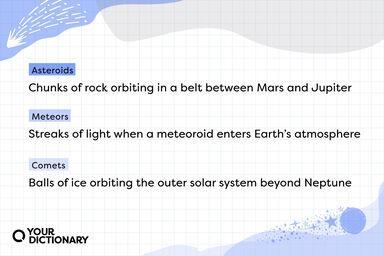
Astronomy. any of thousands of small celestial bodies that revolve about the sun in orbits chiefly between those of Mars and Jupiter ranging in diameter from one mile to 480 miles. Also called asteroids, minor planets. —planetoidal, adj.

zenography

the study and description of Jupiter. —zenographical, adj.

Learn more about Planets

Related Articles

link/cite print suggestion box