The definition of a volcano is a rupture in the Earth's crust where molten lava, hot ash, and gases from below the Earth’s crust escape into the air.
Types of Volcanos
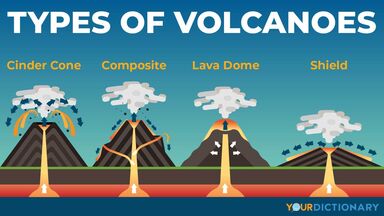
- Plate Volcanoes - The majority of volcanoes are formed when two of the Earth’s plates meet and collide. These volcanoes actually occur on the ocean floor.
If the amount of magma is significant enough, then the magma rises above the surface of the ocean. This is known as an island. When the two plates collide and one plate forces the other plate beneath it, a different reaction occurs.
If this happens, then the friction that is caused during this reaction makes the plate melt that is beneath the other plate. This then causes magma to rise up, and this creates a volcano. The volcanoes that form by this method are usually the most dangerous and the most volatile ones.
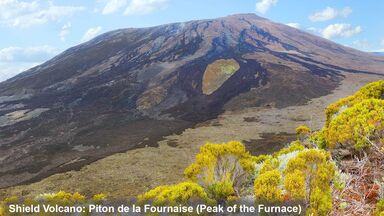
- Shield Volcanoes - Shield volcanoes are extremely broad and flat when compared to other volcanoes.
Their shape is created by a significant amount of lava running down the surface of the volcano, and then cooling. The eruptions of shield volcanoes aren’t as severe as other volcanoes. When a shield volcano erupts, gases escape and the lava rise to the surface to gently flow down the sides of the volcano.
- Composite Volcanoes - Composite volcanoes, also known as strato-volcanoes, are formed by alternate layers of rock fragments and lava. The shape of a composite volcano is large and cone-like.
- Caldera Volcanoes - Caldera volcanoes are formed from considerable amounts of magma erupting from sub-surface magma chambers. When the magma erupts, it leaves an empty space below the surface. The eruption of a caldera volcano generally has the coolest lava; but, they are the most dangerous because their eruption might also cause tsunamis, large pyroclastic surges, and widespread falling of ash.
- Decade Volcanoes - These volcanoes are sixteen volcanoes that have been identified by scientists as noteworthy due to their large eruptions, and their closeness to populated areas. They include: Avachinsky-Koryaksky in Russia, Nevado de Colima in Mexico, Mount Etna in Italy, Galeras in Colombia, Mauna Loa in the United States, Mount Merapa in Indonesia, Mount Nyiragongo in Africa, Mount Rainer in the United States, Sakurajima in Japan, Santa Maria in Guatemala, Santorini in Greece, Taal Volcano in the Philippines, Teide in Spain, Ulawun in New Britain, Mount Unzen in Japan, and Mount Vesuvius in Italy.
Facts About Volcanoes
- Pressure builds in a volcano until the pressure must be expelled. The liquid and heat build up and force the lighter, melted rock buried deep below to the surface toward the surface of the Earth, causing an eruption.
- Natural radioactive decay that occurs within the Earth causes a large amount of heat to be produced, which causes more rocks to melt into magma which travels towards the surface.
- A high and low pressure disturbance cause the magma to rise to the surface and spill over the top.
- Most eruptions occur when gas expands inside the Earth, reducing pressure and causing aggressive volcanic behavior.
- Expelled magma on the surface of the Earth can take up to several hundred years to cool depending on its composition and location.
- The molten lava that flows down the side of a volcano is composed of a mixture of gases, liquid rock, silica and crystals.
- The rock element of the magma is categorized as either Rhyolite, Andesite, or Basalt.
- A major area of volcanic activity is called the "Ring of Fire" which extends around the Pacific Plate from Alaska down both sides of the Pacific Ocean, around Australia and down to the Antarctic continent.
(noun)
- An example of a volcano is Mount St. Helens in Washington state in the U.S.
- An example of a volcano is the eruption of Krakatau in 1883 and the eruption of Mount Tambora in 1815, the two largest explosive and destructive volcanoes since the 1800s.