moon

Moon is defined as the only natural satellite of the Earth.

Facts About the Moon

  • It takes the moon 27.322 days to orbit the Earth. The orbit is almost circular.
  • While the moon rotates, the moon also rotates on its axis. Due to this rotation, we always see the same side of the moon.
  • The force of the moon’s gravity is stronger on the side of the Earth that is facing the moon and weaker on the other side of the Earth.
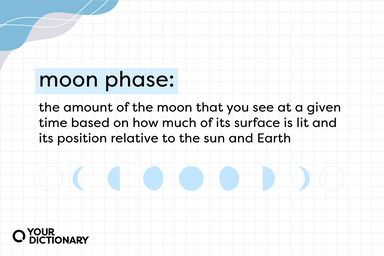
  • It takes 29.53 days for the moon to cycle through its eight different phases.
  • The moon is the fifth largest moon in the solar system and is bigger than Pluto.
  • The moon’s average distance from Earth is 384,400 km or 238,855 miles.
  • The radius of the moon averages 1,079.6 miles, which is around 27% of the Earth’s radius.
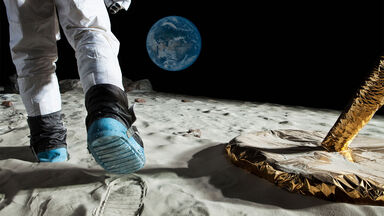
  • The gravity of the moon is about 1/6 of the Earth’s. That means you would weigh much less on the moon and if you dropped something, it would fall much slower than here on Earth.
  • The average distance from the center of the Earth to the center of the moon is 238,897 miles.
  • The temperature of the moon ranges from -280 degrees F to 260 degrees F.
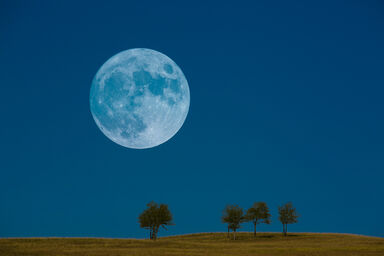
  • The lighter areas are called terrae, which is Latin for "lands." These are the rugged highlands which were the original crust of the moon. They are full of craters from asteroids, meteoroids, and comets.
  • The darker areas are called maria, which is Latin for "seas." Since these areas are smooth and dark, they look like seas. They are actually cratered landscapes that were flooded with lava from volcanoes. When the lava froze, it became dark rock.
(noun)

An example of the moon is the disk or crescent of light you see in the night sky.

Moon is what someone wants to give you when they wish to give you everything.

(noun)

An example of moon is when someone says they want to give you everything.

YourDictionary definition and usage example. Copyright © 2013 by LoveToKnow Corp.

See moon in Webster's New World College Dictionary

noun

  1. the celestial body that revolves around the earth from west to east in c. 27 days with reference to the stars and once in c. 29 days with reference to the sun, and that accompanies the earth in its yearly revolution about the sun: diameter, c. 3,476 km (c. 2,160 mi); mean distance from the earth, c. 384,404 km (c. 238,857 mi); mean density, c. that of the earth; mass, c.; volume, c.: with the
  2. this body as it appears during a particular lunar month or period of time, or at a particular time of the month
  3. a month; esp., a lunar month
  4. moonlight
  5. anything shaped like the moon (i.e., an orb or crescent)
  6. any natural satellite; esp., a natural satellite of a planet

Origin: ME mone < OE mona, akin to Goth mēna < IE *mēn-, month, moon (> L mensis, Gr mēn, month, mēne, moon) < base mē-, to measure

intransitive verb

  1. to behave in an idle, dreamy, or abstracted way, as when in love
  2. Origin: from an earlier slang use of the noun, meaning “buttocks”

    Slang to engage in the prank of momentarily baring one's buttocks in public

Origin: from the notion of behaving as if moonstruck

transitive verb

  1. to pass (time) in mooning
  2. Slang to expose one's buttocks to (someone) as a prank

See moon in American Heritage Dictionary 4

noun
  1. often Moon The natural satellite of Earth, visible by reflection of sunlight and having a slightly elliptical orbit, approximately 356,000 kilometers (221,600 miles) distant at perigee and 406,997 kilometers (252,950 miles) at apogee. Its mean diameter is 3,475 kilometers (2,160 miles), its mass approximately one eightieth that of Earth, and its average period of revolution around Earth 29 days 12 hours 44 minutes calculated with respect to the sun.
  2. A natural satellite revolving around a planet.
  3. The moon as it appears at a particular time in its cycle of phases: a gibbous moon.
  4. A month, especially a lunar month.
  5. A disk, globe, or crescent resembling the natural satellite of Earth.
  6. Moonlight.
  7. Something unreasonable or unattainable: They acted as if we were asking for the moon.
  8. Slang The bared buttocks.
verb mooned, moon·ing, moons
verb, intransitive
  1. To wander about or pass time languidly and aimlessly.
  2. To yearn or pine as if infatuated.
  3. Slang To expose one's buttocks in public as a prank or disrespectful gesture.
verb, transitive
Slang To expose one's buttocks to (others) as a prank or disrespectful gesture: “threatened to moon a passing . . . camera crew” (Vanity Fair).

Origin:

Origin: Middle English moone

Origin: , from Old English mōna; see mē-2 in Indo-European roots

.

Korean-born American religious leader and founder of the Unification Church (1954). He was found guilty in 1982 of conspiracy to evade taxes in the United States.

See moon in Ologies

Moon

See also astronomy; planets; sun.

selenography

the branch of astronomy that deals with the charting of the moon’s surface. —selenographer, selenographist, n. —selenographic, selenographical, adj.

selenolatry

the worship of the moon.

selenology

the branch of astronomy that studies the physical characteristics of the moon. —selenologist, n. —selenological, adj.

selenomancy

a form of divination involving observation of the moon.

Learn more about moon

moon

link/cite print suggestion box