The definition of a planet is a large mass that revolves around a star, such as one of the celestial bodies moving around the sun.
(noun)The Earth is an example of a planet.
See planet in Webster's New World College Dictionary
noun
Origin: ME planete < OFr < LL planeta < Gr planētēs, wanderer < planan, to lead astray, wander < IE base *plā-, flat, spread out > plain
See planet in American Heritage Dictionary 4
noun
Origin:
Origin: Middle English
Origin: , from Old French planete
Origin: , from Late Latin planēta
Origin: , from Greek planētēs
Origin: , variant of planēs, planēt-
Origin: , from planāsthai, to wander; see pelə-2 in Indo-European roots
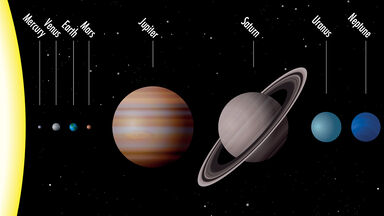
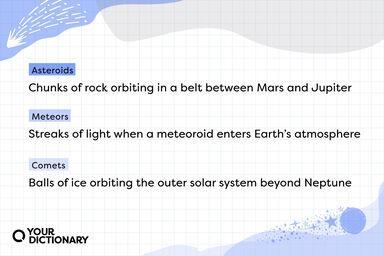
. Usage Note: Clyde Tombaugh's discovery of Pluto in 1930 added a ninth planet to our solar system, and thereafter students of astronomy were taught the familiar list of nine planets: Mercury, Venus, Earth, Mars, Jupiter, Saturn, Uranus, Neptune, and Pluto. But in 2006, the International Astronomical Union (IAU) voted to change the definition of planet, requiring that a clestial body must have enough mass to assume a round shape and “clear the neighborhood around its orbit” in order to qualify as a planet. This means that a planet cannot have other objects in or crossing its orbit except smaller objects that have been captured by its gravity, such as those that revolve around it as moons. Because Neptune's large mass has captured Pluto so that the two planets remain in orbits that cross, Pluto has not cleared its own orbit and was therefore demoted from planet status to that of a newly created category, dwarf planet. Like a planet, a dwarf planet orbits the sun, is large enough to assume a nearly round shape, and does not orbit a planet (as our Moon does). But a dwarf planet does not clear the neighborhood around its orbit and may cross the paths of other objects orbiting the sun. Other dwarf planets include Ceres, whose orbit is in the asteroid belt betwen Mars and Jupiter, and Eris, an object in the Kuiper belt beyond Pluto. At the same meeting the IAU created a third category of objects known as small solar system bodies, which includes asteroids (sometimes referred to as “minor planets,” compounding the difficulty of the term planet,) comets, objects beyond Netpune's orbit, and other nonspherical bodies. Although officially approved, this new scheme of the solar system remains controversial among astronomers and may well be revised.solar system
Learn more about planet
Related Articles