Panama

(panə mä′, -mô′)

noun

  1. a fine, hand-plaited hat made from select leaves of the jipijapa plant
  2. any similar straw hat

Origin: after Panama (city), once a main distributing center

In full Panama hat

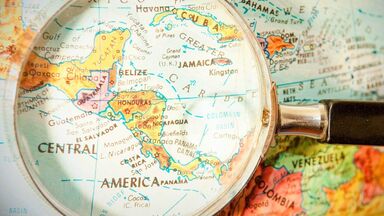
  1. country in Central America, on the Isthmus of Panama: formerly a part of Colombia, it became independent in 1903: 29,761 sq mi (77,081 sq km); pop. 2,329,000
  2. its capital: seaport on the Gulf of Panama: pop. 585,000
  3. arm of the Pacific, on the S coast of Panama: c. 115 mi (185 km) wide
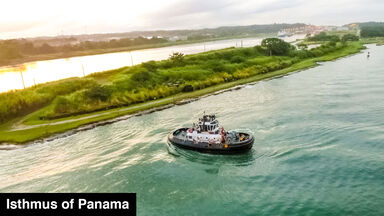
  4. strip of land connecting South America & Central America: 31 mi (50 km) wide at its narrowest point

Origin: < AmSp Panamá < native Ind word

Related Forms:

See Panama in American Heritage Dictionary 4

  1. A country of southeast Central America. The region was inhabited by a variety of Indian peoples when Columbus landed on its Caribbean coast in 1502. In 1513 Balboa crossed the isthmus to discover the Pacific Ocean. Controlled by Spain until 1821, the area then became part of Colombia. Eager for a canal across the isthmus, the United States supported a revolution leading to Panamanian independence in 1903. Panama is the capital. Population: 3,240,000.
  2. also Panama City The capital and largest city of Panama, in the central part of the country on the Gulf of Panama. The original city was founded in 1519, destroyed in 1671, and rebuilt a short distance away in 1673. Population: 408,000.

Related Forms:

  • Panˌa·maˈni·an (-māˈnē-ən) adjective

(click for a larger image)

Panama

, Gulf of

A wide inlet of the Pacific Ocean on the southern coast of Panama.

, Isthmus of Formerly Isthmus of Da·ri·én

An isthmus of Central America connecting North and South America and separating the Pacific Ocean from the Caribbean Sea.

Learn more about Panama

Panama

link/cite print suggestion box