grammar

The definition of grammar is the study of the way words are used to make sentences.

(noun)

An example of grammar is how commas and semicolons are supposed to be used.

YourDictionary definition and usage example. Copyright © 2013 by LoveToKnow Corp.

See grammar in Webster's New World College Dictionary

noun

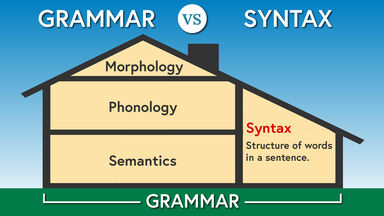
  1. that part of the study of language which deals with the forms and structure of words (morphology), with their customary arrangement in phrases and sentences (syntax), and now often with language sounds (phonology) and word meanings (semantics)
  2. the system of a given language at a given time
  3. a body of rules imposed on a given language for speaking and writing it, based on the study of its grammar (sense ) or on some adaptation of another, esp. Latin, grammar
  4. a book or treatise on grammar
  5. one's manner of speaking or writing as judged by prescriptive grammatical rules: his grammar was poor
    1. the elementary principles of a field of knowledge
    2. a book or treatise on these

Origin: ME gramer < OFr gramaire < L grammatica (ars, art) < Gr grammatikē (technē, art), grammar, learning < gramma, something written (see gram): in L & Gr a term for the whole apparatus of literary study: in the medieval period, specif., “the study of Latin,” hence “all learning as recorded in Latin” (cf. grammar school in Brit usage), and “the occult sciences as assoc. with this learning”: see gramarye, glamour

See grammar in American Heritage Dictionary 4

noun
  1. a. The study of how words and their component parts combine to form sentences.
    b. The study of structural relationships in language or in a language, sometimes including pronunciation, meaning, and linguistic history.
  2. a. The system of inflections, syntax, and word formation of a language.
    b. The system of rules implicit in a language, viewed as a mechanism for generating all sentences possible in that language.
  3. a. A normative or prescriptive set of rules setting forth the current standard of usage for pedagogical or reference purposes.
    b. Writing or speech judged with regard to such a set of rules.
  4. A book containing the morphologic, syntactic, and semantic rules for a specific language.
  5. a. The basic principles of an area of knowledge: the grammar of music.
    b. A book dealing with such principles.

Origin:

Origin: Middle English gramere

Origin: , from Old French gramaire

Origin: , alteration of Latin grammatica

Origin: , from Greek grammatikē

Origin: , from

Origin: feminine of grammatikos, of letters

Origin: , from gramma, grammat-, letter; see gerbh- in Indo-European roots

.

See grammar in Ologies

Grammar

See also language; linguistics

accidence

the aspect of grammar that deals with inflections and word order.

bagrammatism

Medicine. a neurological defect resulting in an inability to use words in grammatical sequence.

amphibology

1. an ambiguity of language.

2. a word, phrase, or sentence that can be interpreted variously because of uncertainty of grammatical construction rather than ambiguity of the words used, as “John met his father when he was sick.” Also amphibologism, amphiboly.amphibological, amphibolous, adj.

anacoluthon

a lack of grammatical sequence or coherence, as “He ate cereal, fruit, and went to the store.” Also anacoluthia.anacoluthic, adj.

antanaclasis

a repetition of words to resume the sense after a long parenthetical digression. See also rhetoric and rhetorical devices.

antiptosis

the substitution of one grammatical case for another, e.g., use of the nominative where the vocative would normally occur. —antiptotic, adj.

apodosis

the clause that expresses the consequence in a conditional sentence. Cf. protasis.

grammar

1. the study of the principles by which a language or languages function in producing meaningful units of expression.

2. knowledge of the preferred forms of expression and usage in language. See also linguistics. —grammarian, n.grammatical, adj.

grammarianism

1. Rare. the principles of the study of grammar followed by a grammarian.

2. excessive emphasis upon the fine points of grammar and usage, especially as a shibboleth; dedication to the doctrine of correctness; grammatism.

grammaticism

a principle or a point of grammar.

grammatism

excessively pedantic behavior about grammatical standards and principles. —grammatist, n.

hypotaxis

arrangement of thoughts by subordination in grammatical construction. Cf. parataxis. —hypotactic, adj.

ingrammaticism

Rare. a word or phrase that violates the rules of grammar. —ingrammatically, adj.

paradigm

1. a declension, conjugation, etc. that provides all the inflectional forms and serves as a model or example for all others.

2. any model or example. —paradigmatic, paradigmatical, adj.

parataxis

arrangement of thoughts as coordinate units in grammatical construction. Cf. hypotaxis.paratactic, adj.

periphrastic

referring to the ability in some languages to use function words instead of inflections, as “the hair of the dog” for “dog’s hair.” —periphrasis, n.

protasis

a clause containing the condition in a conditional sentence. Cf. apodosis. See also drama; wisdom and foolishness. —protatic, adj.

solecism

a violation of conventional usage and grammar, as “I are sixty year old.” —solecist, n.solecistic, solecistical, adj.

syllepsis

the use of a word or expression to perform two syntactic functions, especially to apply to two or more words of which at least one does not agree in logic, number, case, or gender, as in Pope’s line “See Pan with flocks, with fruits Pomona crowned.” —sylleptic, sylleptical, adj.

synesis

the practice of using a grammatical construction that conforms with meaning rather than with strict regard for syntax, such as a plural form of a verb following a singular subject that has a plural meaning.

syntax

the grammatical principles by which words are used in phrases and sentences to construct meaningful combinations. —syntactic, syntactical, adj.

Learn more about grammar

Related Articles

link/cite print suggestion box