Pronoun Definition
prōnoun
pronouns
noun
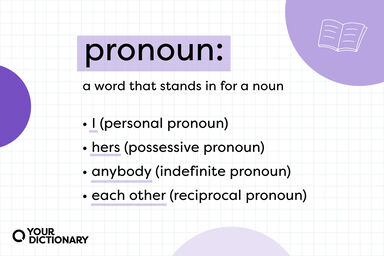
The part of speech that substitutes for nouns or noun phrases and designates persons or things asked for, previously specified, or understood from the context.
American Heritage
Any of a small class of relationship or signal words that assume the functions of nouns within clauses or phrases while referring to other locutions within the sentence or in other sentences: I, you, them, it, ours, who, which, myself, anybody, etc. are pronouns.
Webster's New World
Other Word Forms of Pronoun
Noun
Singular:
pronounPlural:
pronounsOrigin of Pronoun
Late Middle English pronoun, pronoune partial translation of Latin prōnōmen (translation of Greek antōnumiā interchange of names, pronoun) prō- pro- nōmen name, noun
From American Heritage Dictionary of the English Language, 5th Edition
-
pro- +"Ž noun, modeled on Middle French pronom, from Latin pronomen, itself a calque of Ancient Greek ἀντωνυμία (antōnumia).
From Wiktionary

Find Similar Words
Find similar words to pronoun using the buttons below.