Transitive Definition
trănsĭ-tĭv, -zĭ-
adjective
Of, showing, or characterized by transition; transitional.
Webster's New World
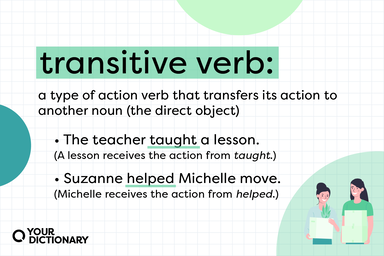
Expressing an action thought of as passing over to and having an effect on some person or thing; taking a direct object.
Webster's New World
Designating a relation having the property that, whenever a first element bears a particular relation to a second that in turn bears this same relation to a third, the first element bears this relation to the third.
Identity and equality are transitive relations.
Webster's New World
Making a transit or passage.
Wiktionary
Affected by transference of signification.
Wiktionary
Antonyms:
Origin of Transitive
-
Late Latin trānsitīvus passing over (translation of Greek diabibastikos) from trānsitus past participle of trānsīre to go over transient
From American Heritage Dictionary of the English Language, 5th Edition
-
From Latin transitivus, from transitus, from trans (“across") + itus, from eo (“to go").
From Wiktionary
Related Articles



Find Similar Words
Find similar words to transitive using the buttons below.