monopoly Hear it!

monopoly Definition

mo·nopo·ly (mə näpə lē)

noun pl. -·lies

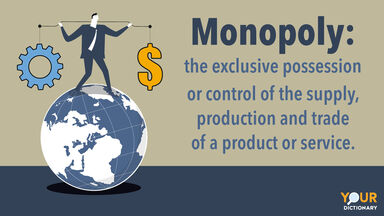
  1. exclusive control of a commodity or service in a given market, or control that makes possible the fixing of prices and the virtual elimination of free competition
  2. an exclusive privilege of engaging in a particular business or providing a service, granted by a ruler or by the state
  3. exclusive possession or control of something
  4. something that is held or controlled as a monopoly
  5. a company or combination that has a monopoly

Etymology: L monopolium < Gr monopōlion, right of exclusive sale, monopōlia, exclusive sale < monos, single (see mono-) + pōlein, to sell < IE base *pel- > Lith penas, wages

a game played on a special board by two or more players: they move according to the throw of dice, engaging in mock real estate transactions with play money

monopoly Synonyms

monopoly

n.

monopoly applies to the exclusive control of a commodity or service in a given market, or control that makes possible the fixing of prices and the virtual elimination of competition; trust is a combination of corporations, organized for the purpose of gaining a monopoly, in which stock is turned over to trustees who issue stock certificates to the stockholders: trusts are now illegal in the U.S.; cartel, the European term for a trust, now usually implies an international trust; a syndicate is now usually a group of bankers, corporations, etc. organized to buy large blocks of securities, afterward selling them in small parcels to the public at a profit; a corner is a temporary speculative monopoly of some stock or commodity for the purpose of raising the price

monopoly Law Definition

n

The domination of a commercial market by only one supplier, worldwide or in a particular region.

monopoly Telecom Definition

A condition in which a single company is the exclusive manufacturer of a product or provider of a service or controls an entire industry, thereby allowing the company to fix prices. A monopolistic condition can arise when a company invents and patents a product that is so compelling that an entire industry builds up around it. If the company continues to develop and patent further versions of the product, it can extend that monopolistic condition, perhaps acquiring or overwhelming competitors. Natural monopoly, a concept developed by political economist John Stuart Mill (1806

monopoly Usage Examples

Converse of object

  • nationalize: But Chavez is in possession of an already nationalized oil monopoly with massive current sales revenues.
  • regulate: Ofgem's aim is the bring choice and value to all gas and electricity customers by promoting competition and regulating monopolies.
  • retain: Does anyone seriously argue that retaining a state monopoly in telecommunications is a sensible policy in today's rapidly changing information society?
  • possess: Spain possessed the lucrative monopoly of the expensive cochineal dye.
  • break: At much the same the British broke the Dutch clove monopoly in India.

Adjective modifier

  • re-assembled: Isn't it appropriate for the name of the re-assembled monopoly to be re-cristened ATT?
  • state-run: A blueprint masterminded by EU health Commissioner Markos Kyprianou also contains moves to control sales through a state-run monopoly.
  • virtual: Bridgnorth boats had a virtual monopoly on the carriage of coal.
  • regulated: The benefits of competition have to be weighed against the problems of private interests, regulated monopolies and market distortion.
  • capitalist: Attempts to put money into saving jobs in Britain often fall foul of the EU's policy of freedom for the capitalist monopolies.
  • lucrative: Spain possessed the lucrative monopoly of the expensive cochineal dye.

Preposition: on

  • morality: Why do you believe Christians have a monopoly on morality?
  • truth: Somehow the notion that we don't have a monopoly on truth seems to threaten us.

Modifies a noun

  • capitalism: Late monopoly capitalism: the sense of a system of exchange no longer grounded on agents or even nations.
  • capitalist: They began the campaign against the Rover sell-off determined to fight their class battles against the monopoly capitalists.
  • situation: We found that a monopoly situation exists in favor of the PRS.
  • supplier: Price control may also be of value where monopoly suppliers are publicly owned.

Preposition: of

wisdom: No country, not even one the size of China, has a monopoly of wisdom.

Noun used with modifier

  • state: One such was over the defense of the state monopoly of foreign trade.
  • broadcasting: The MMD has primarily maintained its broadcasting monopoly through the manner in which they issue licenses.