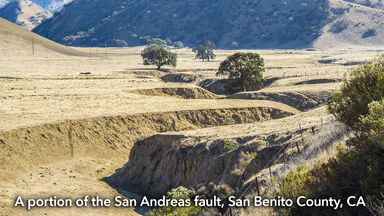
Earthquakes
See also geology.
bathyseism
an earthquake occurring at very deep levels of the earth.
bradyseism
the slow upward and downward motion of the earth’s crust. —bradyseismic, adj.
any major disaster, as an earthquake, flood, etc. See also water. —cataclysmal, adj.
coseism
a line drawn about an epicenter through all points affected by the same seismic shock. —coseismic, adj.
a point on the earth’s surface directly above the true center of the seismic disturbance from which the shock waves of an earthquake seem to radiate.
macroseism
a major earthquake. —macroseismic, adj.
megaseism
a violent earthquake. —megaseismic, adj.
an almost imperceptible earth tremor caused by a violent sea storm or an earthquake and detected only by a microseismometer. —microseismic, adj.
the intensity, frequency, and distribution of earthquakes in a specific area.
seismism, seism
an earthquake. —seismic, adj.
the record of an earthquake’s vibrations and intensity made by a seismograph.
any of various devices for measuring and recording the vibrations and intensities of earthquakes. —seismographer, n. —seismographic, seismographical, adj.
1. the scientific measuring and recording of the shock and vibrations of earthquakes.
2. seismology.
the branch of geology that studies earthquakes and their effects. Also seismography. —seismologist, n. —seismologic, seismological, adj.
a special seismograph equipped to measure the actual movement of the ground. —seismometry, n. —seismometric, adj.
teleseism
an earthquake that occurs in a part of the world far away from a recording station. —teleseismic, adj.
tromometer
an instrument for detecting or measuring very slight earth tremors.
Learn more about Earthquakes
Related Articles