classical

The definition of classical is a style of music that places importance on formal composition.

(adjective)

An example of classical is Beethoven.

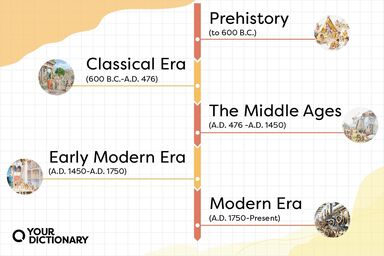
Classical is defined as music, literature, art or culture of the ancient Greeks and Romans.

(adjective)

An example of classical is Homer's Iliad.

YourDictionary definition and usage example. Copyright © 2013 by LoveToKnow Corp.

See classical in Webster's New World College Dictionary

adjective

  1. classic (senses & )
  2. of the art, literature, and culture of the ancient Greeks and Romans, or their writers, artists, etc.
  3. characteristic of or derived from the literary and artistic standards, principles, and methods of the ancient Greeks and Romans
  4. well versed in or devoted to Greek and Roman culture, literature, etc.: a classical scholar
  5. designating or of a specified area or course of study that is or has been standard and traditionally authoritative, not new, recent, and experimental: classical political science
    1. of, characteristic of, or like a style of music marked by an emphasis on formal composition, as in instrumental works in the sonata form, by precise standards of performance appropriate to a symphony orchestra, and by a sense of balance, order, clarity, etc.
    2. designating or of the period (c. 1750-c. 1830) characterized by this style
    3. designating or of art music of the European tradition, including such forms as the symphony, the opera, chamber music, the sonata, etc.: distinguished from folk or popular music or jazz

Related Forms:

See classical in American Heritage Dictionary 4

adjective
  1. a. Of or relating to the ancient Greeks and Romans, especially their art, architecture, and literature.
    b. Conforming to the artistic and literary models of ancient Greece and Rome.
    c. Versed in the classics: a classical scholar.
  2. Of or relating to the most artistically developed stage of a civilization: Chinese classical poetry.
  3. Music
    a. Of or relating to European music during the latter half of the 18th and the early 19th centuries.
    b. Of or relating to music in the educated European tradition, such as symphony and opera, as opposed to popular or folk music.
  4. Of, relating to, or being a variety of a language that is epitomized by a prestigious body of literature.
  5. a. Standard and authoritative rather than new or experimental: classical methods of navigation.
    b. Well-known; classic: the classical argument between free trade and protectionism.
  6. Of or relating to physics that can be described without the use of quantum mechanics or relativity.
  7. Relating to or consisting of studies in the humanities and general sciences: a classical curriculum.

Related Forms:

  • clasˌsi·calˈi·ty (-kălˈĭ-tē), clasˈsi·cal·ness noun
  • clasˈsi·cal·ly adverb

Learn more about classical

link/cite print suggestion box