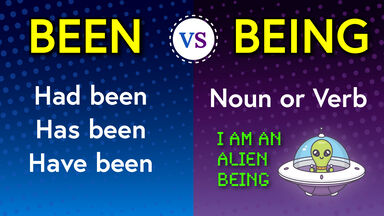
The definition of be is to exist or to exist as an example of something.
(verb)See B & E in Webster's New World College Dictionary
or B and E
intransitive verb was or were, been, being
Origin: ME been, beon < OE beon: be is a defective verb with parts from three unrelated stems: 1) the IE substantive verb, base *es-, as in am, is, Sans ásmi, asti, Goth im, ist; 2) IE base *wes-, stay, remain, as in was, were, Sans vasati, (he) lingers, stays, Goth wisan, was, wēsum, remain, be; 3) IE base *bheu-, grow, become, (it) occurs, is there, L fieri, as in be, been, Sans bhávati, be, become: see bondage
auxiliary verb
Origin: ME bi-, be- < OE (akin to Goth bi-, Ger be-), at, near < Gmc base of by
See B & E in American Heritage Dictionary 4
verb First and third person singular past indicative was was (wŭz, wŏz; wəz when unstressed), second person singular and plural and first and third person plural past indicative were were (wûr), past subjunctive were were, past participle been been (bĭn), present participle be·ing (bēˈĭng), first person singular present indicative am am (ăm), second person singular and plural and first and third person plural present indicative are (är), third person singular present indicative Is is (ĭz), present subjunctive be be verb, intransitive
Origin:
Origin: Middle English ben
Origin: , from Old English bēon; see bheuə- in Indo-European roots
Origin: . See am1
Origin: , is, etc. for links to other Indo-European roots
. Usage Note: Traditional grammar requires the nominative form of the pronoun in the predicate of the verb be: It is I (not me); That must be they (not them), and so forth. Nearly every speaker of Modern English finds this rule difficult to follow. Even if everyone could follow it, in informal contexts the nominative pronoun often sounds pedantic and even ridiculous, especially when the verb is contracted, as in It's we. But constructions like It is me have been condemned in the classroom and in writing handbooks for so long that there seems little likelihood that they will ever be entirely acceptable in formal writing. • The traditional rule creates additional problems when the pronoun following be also functions as the object of a verb or preposition in a relative clause, as in It is not them/they that we have in mind when we talk about “crime in the streets” nowadays, where the plural pronoun serves as both the predicate of is and the object of have. In this example, 57 percent of the Usage Panel prefers the nominative form they, 33 percent prefer the objective them, and 10 percent accept both versions. Writers can usually revise their sentences to avoid this problem: They are not the ones we have in mind, We have someone else in mind, and so on. See Usage Notes at I1, we.Our Living Language In place of the inflected forms of be, such as is and are, used in Standard English, African American Vernacular English (AAVE) and some varieties of Southern American English may use zero copula or an invariant be, as in He be working, instead of the Standard English He is usually working. As an identifying feature of the vernacular of many African Americans, invariant be in recent years has been frequently seized on by writers and commentators trying to imitate or parody Black speech. However, most imitators use it simply as a substitute for is, as in John be sitting in that chair now, without realizing that within AAVE, invariant be is used primarily for habitual or extended actions set in the present. Among African Americans the form is most commonly used by working-class speakers and young persons. Since the 1980s, younger speakers have tended to restrict the use of the form to progressive verb forms (as in He be walking), whereas their parents use it with progressives, adjectives (as in He be nice), and expressions referring to a location (as in He be at home). Younger speakers also use invariant be more exclusively to indicate habitual action, whereas older speakers more commonly omit be forms (as in He walking) or use present tense verb forms (such as He walks), sometimes with adverbs like often or usually, to indicate habituality. • The source of invariant habitual be in AAVE is still disputed. Some linguists suggest that it represents influence from finite be in the 17th- to 19th-century English of British settlers, especially those from the southwest of England. Other linguists feel that contemporaneous Irish or Scotch-Irish immigrants may have played a larger role, since their dialects mark habitual verb forms with be and do be, as in “They be shooting and fishing out at the Forestry Lakes” (archival recordings of the Royal Irish Academy) and “Up half the night he does be” (James Joyce). Other linguists believe that it may have evolved from the does be construction indicating habitual action used by Gullah speakers from coastal South Carolina and Georgia and by Caribbean Creole immigants. Still other linguists suggest that invariant be is a mid- to late-20th-century innovation within AAVE, essentially a response to the wide range of meanings that the English progressive tense can express. See Notes at all, like2, zero copula.Origin:
Origin: Middle English bi-, be-
Origin: , from Old English be-, bi-; see ambhi in Indo-European roots
.Learn more about B & E
Related Articles