Origin: short for usquebaugh < Ir uisce beathadh (or Gael uisge beatha) < uisce, water + beathadh, life < IE base *gwi-, *gwei-, to live > bio-
See whiskey in American Heritage Dictionary 4
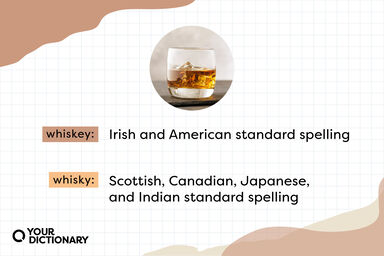
also whis·ky
noun pl. whis·keys also whis·kiesOrigin:
Origin: Shortening and alteration of usquebaugh
. Word History: Many connoisseurs of fine whiskey wouldn't dream of contaminating their libations with water, but they really can't avoid it. Not only is water used in distilling whiskey, but the words whiskey and water share a common Indo-European root, *wed-, “water, wet.” This root could appear in several guises, as *wed-, *wod-, or *ud-. Water is a native English word that goes back by way of prehistoric Common Germanic *watar to the Indo-European suffixed form *wod-ōr, with an o. Whiskey is a shortened form of usquebaugh, which English borrowed from Irish Gaelic uisce beatha and Scottish Gaelic uisge beatha. This compound descends from Old Irish uisce, “water,” and bethad, “of life,” and meaning literally “water of life.” (It thus meant the same thing as the name of another drink, aquavit, which comes from Latin aqua vītae, “water of life.”) Uisce comes from the Indo-European suffixed form *ud-skio-. Finally, the name of another alcoholic drink, vodka, comes into English from Russian, where it means literally “little water,” as it is a diminutive of voda, “water”—a euphemism if ever there was one. Voda comes from the same Indo-European form as English water, but is differently suffixed: *wod-ā. Whiskey, water, and vodka—etymology can mix a potent cocktail.Learn more about whiskey