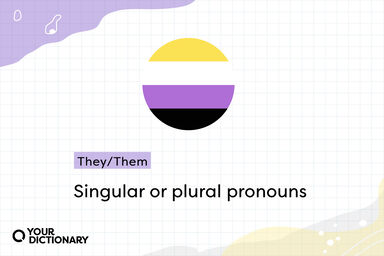
they

They is a general reference to people, or to people who were previously mentioned.

(pronoun)

An example of they is someone saying that a group of people are standing at a bus stop, "They are standing at the bus stop."

YourDictionary definition and usage example. Copyright © 2013 by LoveToKnow Corp.

See they in Webster's New World College Dictionary

pronoun sing. he, she, it

  1. the persons, animals, or things previously mentioned: personal pronoun in the third person plural: they is the nominative form, them the objective, theirs the possessive, and themselves the reflexive and intensive; their is the possessive pronominal adjective
  2. people: they say it's so
  3. the person or group just mentioned: used sometimes as a generic form with a collective antecedent such as everyone, somebody, or no one to avoid the masculine implications of generic he: everyone thinks they are right about this issue

Origin: ME thei < ON thei-r, nom. masc. pl. of the demonstrative pron.; like their & them (ME theim), also < the ON demonstrative forms, thei replaced earlier ME he (hi) because the native pronouns were phonetically confused with the forms of the pers. pron. (ME he, hire, hem, him, etc.): cf. their, them, she

See they in American Heritage Dictionary 4

pron.
  1. Used to refer to the ones previously mentioned or implied.
  2. Usage Problem Used to refer to the one previously mentioned or implied, especially as a substitute for generic he: Every person has rights under the law, but they don't always know them. See Usage Note at he1.
  3. a. Used to refer to people in general.
    b. Used to refer to people in general as seen in a position of authority.

Origin:

Origin: Middle English

Origin: , from Old Norse their, masculine pl. demonstrative and personal pron.; see to- in Indo-European roots

.

Usage Note: The use of the third-person plural pronoun they to refer to a singular noun or pronoun is attested as early as 1300, and many admired writers have used they, them, themselves, and their to refer to singular nouns such as one, a person, an individual, and each. W.M. Thackeray, for example, wrote in Vanity Fair in 1848, “A person can't help their birth,” and more recent writers such as George Bernard Shaw and Anne Morrow Lindbergh have also used this construction, in sentences such as “To do a person in means to kill them,” and “When you love someone you do not love them all the time.” The practice is widespread and can be found in such mainstream publications as the Christian Science Monitor, Discover, and the Washington Post. The usage is so common in speech that it generally passes unnoticed. • However, despite the convenience of third-person plural forms as substitutes for generic he and for structurally awkward coordinate forms like his/her, many people avoid using they to refer to a singular antecedent out of respect for the traditional grammatical rule concerning pronoun agreement. Most of the Usage Panelists reject the use of they with singular antecedents. Eighty-two percent find the sentence The typical student in the program takes about six years to complete their course work unacceptable. Thus, the writer who chooses to use they in similar contexts in writing should do so only if assured that the usage will be read as a conscious choice rather than an error. • Interestingly, Panel members do seem to distinguish between singular nouns, such as the typical student, and pronouns that are grammatically singular but semantically plural, such as anyone and everyone. Sixty-four percent of panel members accept the sentence No one is willing to work for those wages anymore, are they? in informal speech. See Usage Notes at any, anyone, he1, she.Word History: Incredible as it may seem, the English pronoun they is not really an English pronoun. They comes from Old Norse and is a classic example of the profound impact of that language on English: because pronouns are among the most basic elements of a language, it is rare for them to be replaced by borrowings from foreign sources. The Old Norse pronouns their, theira, theim worked their way south from the Danelaw, the region governed by the Old Norse-speaking invaders of England, and first appeared in English about 1200, gradually replacing the Old English words hīe, him, hīora. The nominative or subject case (modern English they) seems to have spread first. William Caxton, who brought the printing press to England, uses they, hir, hem in his earlier printed works (after 1475) and thei, their, theim in his later ones. This is clear evidence of the spread of these Norse forms southward, since Caxton did not speak northern English natively (he was born in Westminster). The native English objective case of the third plural, him or hem, may well survive, at least colloquially, in modern English ’em, as in “Give ’em back!”

Learn more about they

link/cite print suggestion box