economics

Economics is defined as a science that deals with the making, distributing, selling and purchasing of goods and services.

(noun)

An example of economics is the study of the stock market.

YourDictionary definition and usage example. Copyright © 2013 by LoveToKnow Corp.

See economics in Webster's New World College Dictionary

noun

  1. the science that deals with the production, distribution, and consumption of wealth, and with the various related problems of labor, finance, taxation, etc.
  2. economic factors

See economics in American Heritage Dictionary 4

noun
  1. (used with a sing. verb) The social science that deals with the production, distribution, and consumption of goods and services and with the theory and management of economies or economic systems.
  2. (used with a sing. or pl. verb) Economic matters, especially relevant financial considerations: “Economics are slowly killing the family farm” (Christian Science Monitor).

See economics in Ologies

Economics

See also finance; money

aphnology

Rare. the science of wealth; plutology.

autarky

a national policy of economic self-sufficiency or independence. —autarkist, n. —autarkie, autarkical, adj.

bilateralism

the practice of promoting trade between two countries through agreements concerning quantity and price of commodities. Cf. multilateralism.bilateralistic, adj.

boycottism

the principles behind, and means of carrying out, a boycott. —boycotter, n.

cameralism

the theories and adherence to the theories of the cameralists. —cameralist, n. —cameralistic. adj.

cameralist

a mercantilist economist of the seventeenth and eighteenth centuries who believed in the doctrine that a nation’s wealth could be made greater by increasing its supply of money. —cameralistic, adj.

capitalism

a system of economics under which ownership of and investment in the means of production and distribution depends chiefly upon corporations and private individuals. —capitalist, n. —capitalistic, adj.

cartelism

the practice of controlling production and prices by agreements between or among international companies. —cartel, n.

chrysology

the study of the production of wealth, especially as attained from precious metals.

Cobdenism

the economic doctrines of Richard Cobden (1804-65), who believed in peace and the withdrawal from European competition for balance of power.

Colbertism

the mercantilist theories of Jean Colbert in the 17th century, especially his advocacy of high protective tariffs.

commercialism

1. the principles, practice, and spirit of commerce.

2. an excessive emphasis on high profit, commercial success, or immediate results.

3. a commercial custom, practice, or expression. —commercialist, n. —commercialistic, adj.

consumerism

the principles and practices associated with the utilization of economic goods.

disintermediation

an economic phenomenon of the late 1970s and early 1980s in which investors, flnding that conventional savings and thrift methods did not pay sufficient interest to keep pace with inflation, transferred their funds to the money market and related savings and investment instruments, leading to a rapid growth in those resources and a loss of funds from institutions like savings banks.

economese

language and jargon typical of economists and the field of economics.

econometrics

mathematical methods used in the science of economics to prove and develop economic theories.

economics

the study of the production, use, and consumption of goods and services in society. —economie, economical, adj. —economist, n.

economism

a theory or doctrine that attaches principal importance to economic goals. —economist, n.

Fabianism

a late 19th-century English movement that favored the gradual development of socialism by peaceful means. —Fabian, n., adj.

Fordism

the theory of Henry Ford stating that production efficiency is dependent on successful assembly-line methods.

industrialism

a system of social and economic organization based upon highly mechanized industry. —industrialist, n., adj.

inflationism

the quality of advocating economic inflation. —inflationist, n.

joint stockism

the principle of contribution and division of capital or stock by a number of persons.

Keynesianism

the economic theories of John Maynard Keynes (1883-1946), English economist, and his advocates, especially his emphasis upon deficit spending by government to stimulate business investment. —Keynesian, n., adj.

laissez-faireism

the economic doctrine that the government should intervene as little as possible in economic affairs. —laissez-faireist, n., adj.

macroeconomics

the division of economics dealing with broad, general aspects of an economy, as the import-export balance of a nation as a whole. Cf. microeconomics. —macroeconomist, n. —macroeconomic, adj.

Malthusianism

the theories of Thomas Malthus (1766-1834), English economist, stating that population growth tends to increase faster than production and that food and necessities will be in short supply unless population growth is restricted or war, disease, and famine intervene. —Malthusian, n., adj.

Manchesterism

the policies and principles of an English school of economists based in Manchester. —Manchesterist, n.

mercantilism

a political and economic policy seeking to advance a state above others by accumulating large quantities of precious metals and by exporting in large quantity while importing in small. —mercantilist, n. —mercantilistic, adj.

microeconomics

the division of economics dealing with particular aspects of an economy, as the price-cost relationship of a business. Cf. macroeconomies. —microeconomist, n. —microeconomic, adj.

monetarism

1. an economic theory maintaining that stability and growth in the economy are dependent on a steady growth rate in the supply of money.

2. the principle put forward by American economist Milton Friedman that control of the money supply and, thereby, of rate in the supply of credit serves to control inflation and recession while fostering prosperity. — monetarist, n., adj.

multilateralism

the practice of promoting trade among several countries through agreements concerning quantity and price of commodities, as the Common Market, and, sometimes, restrictive tariffs on goods from outsiders.

nationalization

the act or process of the taking over of private industry by government. See also government.

Neo-Malthusianism

the belief that the use of contraceptives as a means of lowering the population will eliminate such adverse elements as vice and elevate the Standard of living. —Neo-Malthusian, n., adj.

Owenism

the principles of social and labor reform along communistic lines developed by Robert Owen (1771-1858). —Owenite, n.

pastoralism

the herding or tending of cattle as a primary economic activity or occupation. Also pasturage. —pastoralist, n. —pastoral, adj.

plutology

the branch of economics that studies wealth; theoretical economics. Also called plutonomy.

privatization

the act or process of transferring to private ownership industry operated by a government, of ten industry that has been nationalized. See also government.

protectionism

the theory or practice of a method of fostering or developing industry through restrictive tariffs on foreign imports. —protectionist, n., adj.

Reaganomics

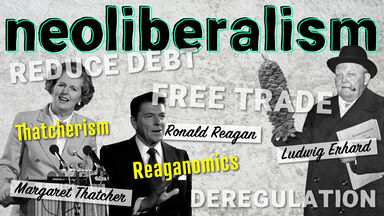
the economic theories and policies of the administration of President Ronald Reagan (1981- ), basically a policy of supply-side economics with emphasis on defense spending, encouragement of private and corporate development and investment, and reduction in government spending on social services.

Ricardian

a believer in the economic theories of David Ricardo, English economist, especially that rental income is an economic surplus. —Ricardian, adj.

Saint-Simonism

the theory of the Comte de Saint-Simon (1760-1825), who proposed a socialism in which all property and production be state-controlled with distribution on the basis of an individual’s job and ability. —Saint-Simonist, n.

Learn more about economics

Related Articles

link/cite print suggestion box