Ax Definition
aks
axed, axes, axing
noun
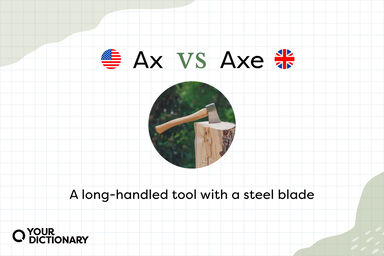
A tool with a bladed, usually heavy head mounted crosswise on a handle, used for felling trees or chopping wood.
American Heritage
A tool for chopping trees and splitting wood: it has a long wooden handle and a metal head with a blade usually on only one side.
Webster's New World
Any of various bladed, handheld implements used as a cutting tool or weapon.
American Heritage
Any similar tool or weapon, as a battle-ax, headsman's ax, etc.
Webster's New World
A sudden termination of employment.
My colleague got the ax yesterday.
American Heritage
Synonyms:
- disemployment
- decollation
- defenestration
- surplusing
- puncturer
- gallows-tree
- axe
- have one's own ends to promote
- have one's own agenda
- have a hidden agenda
- have an ulterior motive
- get-the-sack
- get-the-boot
- be discharged
- be dismissed
verb
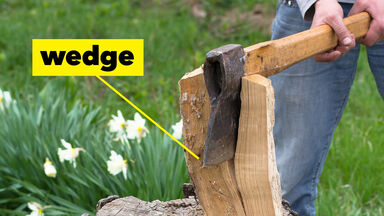
To chop or fell with or as if with an ax.
Axed down the saplings; axed out a foothold in the ice.
American Heritage
To trim, split, etc. with an ax.
Webster's New World
To remove ruthlessly or suddenly.
A social program that was axed to effectuate budget cuts.
American Heritage
To cut off, remove, get rid of, etc.
Webster's New World
Alternative spelling of axe.
Wiktionary
abbreviation
Axiom.
Webster's New World
Axis.
Webster's New World
idiom
ax to grind
- A selfish or ulterior aim:
He claimed to be disinterested, but I knew he had an ax to grind.
American Heritage
have an ax to grind
- to have an object of one's own to gain or promote
Webster's New World