than

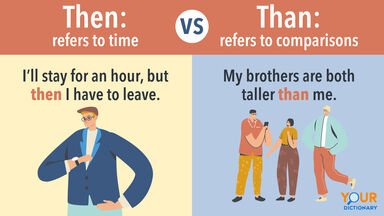
Than is defined as a way to introduce the second part of a comparison or to show a difference.

(conjunction)

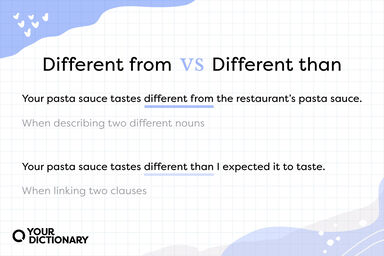
An example of than used as a conjunction is in the phrase "She draws differently than he does" which means that she and he did not draw in the same way.

Than means in comparison.

(preposition)

An example of than used as a preposition is in the sentence, "She is taller than he is," which means that she is the taller of the two people.

YourDictionary definition and usage example. Copyright © 2013 by LoveToKnow Corp.

See than in Webster's New World College Dictionary

conjunction

  1. introducing the second element in a comparison, following an adjective or adverb in the comparative degree: if the first element is a subject, object, predicate nominative, etc., the second element is construed in the same way: [he is taller than I; she arrived earlier than the others; Mom liked you better than me]: sometimes, informally, this use of than is construed as a preposition and the second element as its object [he is taller than me]
  2. expressing exception, following an adjective or adverb: none other than Sam
  3. when: used esp. following an inverted construction introduced by scarcely, hardly, barely, etc.: scarcely had I seen her than she spoke to me
  4. indicating difference or distinction, as:: this mainly informal use of than with different and differently is objected to by some
    1. introducing an adverbial clause: Paris was different than I'd thought it would be
    2. linking nouns or pronouns: her story is different than his

Origin: ME than, thene, thonne < OE thenne, thanne, thonne, orig., then: for IE base see that

compared with: chiefly in the phrase , compared or in comparison with whom (or which): a writer than whom there is none finer

See than in American Heritage Dictionary 4

conjunction
  1. Used after a comparative adjective or adverb to introduce the second element or clause of an unequal comparison: She is a better athlete than I.
  2. Used to introduce the second element after certain words indicating difference: He draws quite differently than she does.
  3. When. Used especially after hardly and scarcely: I had scarcely walked in the door than the commotion started.
preposition
Usage Problem
In comparison or contrast with: could run faster than him; outclassed everyone other than her.

Origin:

Origin: Middle English

Origin: , from Old English thanne, than; see to- in Indo-European roots

.

Usage Note: Since the 18th century grammarians have insisted that than should be regarded as a conjunction in all its uses, so that a sentence such as Bill is taller than Tom should be construed as an elliptical version of the sentence Bill is taller than Tom is. According to this view, the case of a pronoun following than is determined by whether the pronoun serves as the subject or object of the verb that is “understood.” Thus, the standard rule requires Pat is taller than I (not me) on the assumption that this sentence is elliptical for Pat is taller than I am but allows The news surprised Pat more than me, since this sentence is taken as elliptical for The news surprised Pat more than it surprised me. However, than is quite commonly treated as a preposition when followed by an isolated noun phrase, and as such occurs with a pronoun in the objective case: John is taller than me. Though this usage is still widely regarded as incorrect, it is predominant in speech and has reputable literary precedent, appearing in the writing of such respected authors as Shakespeare, Johnson, Swift, Scott, and Faulkner. It is also consistent with the fact that than is clearly treated as a preposition in the than whom construction, as in a poet than whom (not than who) no one has a dearer place in the hearts of his countrymen. Still, the writer who risks a sentence like Mary is taller than him in formal writing must be prepared to defend the usage against objections of critics who are unlikely to be dissuaded from the conviction that the usage is incorrect. • Comparatives using as . . . as can be analyzed as parallel to those using than. Traditional grammarians insist that I am not as tall as he is the only correct form; in formal writing, one should adhere to this rule. However, one can cite both literary precedent and syntactic arguments in favor of analyzing the second as as a preposition (which would allow constructions such as I am not as tall as him). See Usage Note at as1.

Learn more about than

link/cite print suggestion box