Syllogism Definition
sĭlə-jĭzəm
syllogisms
noun
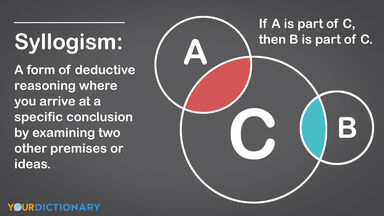
An argument or form of reasoning in which two statements or premises are made and a logical conclusion is drawn from them (Ex.: All mammals are warmblooded [major premise]; whales are mammals [minor premise]; therefore, whales are warmblooded [conclusion])
Webster's New World
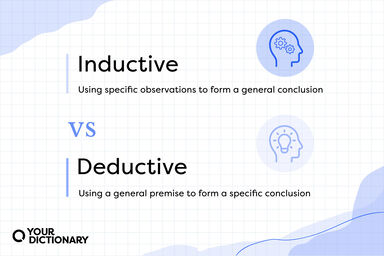
Reasoning from the general to the particular; deductive logic.
Webster's New World
A subtle or specious piece of reasoning.
American Heritage
(logic) An inference in which one proposition (the conclusion) follows necessarily from two other propositions, known as the premises.
Wiktionary
Other Word Forms of Syllogism
Noun
Singular:
syllogismPlural:
syllogismsOrigin of Syllogism
-
Middle English silogisme from Old French from Latin syllogismus from Greek sullogismos from sullogizesthai to infer sun- syn- logizesthai to count, reckon (from logos reason leg- in Indo-European roots)
From American Heritage Dictionary of the English Language, 5th Edition
-
From Old French silogisme (“syllogism"), from Latin syllogismus, from Ancient Greek συλλογισμός (syllogismos, “inference, conclusion").
From Wiktionary
Related Articles




Find Similar Words
Find similar words to syllogism using the buttons below.