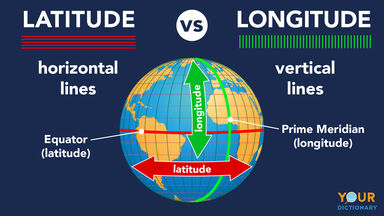
meridian

A meridian is defined as a large imaginary circle that passes through two poles, particularly on a globe, or the highest stage of development.

(noun)

  1. An example of a meridian is the Prime Meridian.
  2. An example of a meridian is the height of a civilization.

The definition of meridian is at midday or the greatest or highest point.

(adjective)

  1. An example of meridian used as an adjective is in the phrase a "meridian activity" which means something that is done at noon.
  2. An example of meridian used as an adjective is in the phrase a "meridian accomplishment" which means the best accomplishment.

YourDictionary definition and usage example. Copyright © 2013 by LoveToKnow Corp.

See meridian in Webster's New World College Dictionary

adjective

  1. of or at noon
  2. of or passing through the highest point in the daily course of any celestial body
  3. of or at the highest point of prosperity, splendor, power, etc.
  4. of or along a meridian
  5. Rare southern

Origin: OFr meridien < L meridianus, of noon, southern < meridies, noon, the south < older medidies < medius, mid + dies, day: see deity

noun

  1. Archaic the highest apparent point reached by a celestial body in its course
    1. the highest point of power, prosperity, splendor, etc.; zenith; apex
    2. the middle period of one's life, regarded as the highest point of health, vigor, etc.; prime
  2. Obsolete noon
  3. Astron. a great circle passing through the celestial poles, the observer's zenith and nadir, and the horizon's north and south points
    also called celestial meridian
  4. Geog.
    1. a great circle of the earth passing through the geographical poles and any given point on the earth's surface
    2. either half of such a circle between the poles
    3. any of the lines of longitude running north and south on a globe or map, representing such a half circle
  5. Archaic distinctive character as of a particular place

See meridian in American Heritage Dictionary 4

noun
  1. a. An imaginary great circle on the earth's surface passing through the North and South geographic poles. All points on the same meridian have the same longitude.
    b. Either half of such a great circle from pole to pole.
  2. Astronomy A great circle passing through the two poles of the celestial sphere and the zenith of a given observer.
  3. Mathematics
    a. A curve on a surface of revolution, formed by the intersection of the surface with a plane containing the axis of revolution.
    b. A plane section of a surface of revolution containing the axis of revolution.
  4. Any of the longitudinal lines or pathways on the body along which the acupuncture points are distributed.
  5. Archaic
    a. The highest point in the sky reached by the sun or another celestial body; a zenith.
    b. Noon.
  6. The highest point or stage of development; peak: “Men come to their meridian at various periods of their lives” (John Henry Newman).
  7. Midwestern U.S. See median strip. See Regional Note at neutral ground.
adjective
  1. Of or relating to a meridian; meridional.
  2. Of or at midday: the meridian hour.
  3. Of, relating to, or constituting the highest point, as of development or power: the empire in its meridian period.

Origin:

Origin: Middle English

Origin: , from Old French, midday

Origin: , from Latin merīdiānus, of midday

Origin: , from merīdiēs, midday

Origin: , from merīdiē, at midday

Origin: , alteration of earlier *medīdiē

Origin: , from *mediei diē

Origin: : *mediei

Origin: , dative (locative) of medius, middle; see medhyo- in Indo-European roots

Origin: + diē

Origin: , dative of diēs, day; see dyeu- in Indo-European roots

.

(click for a larger image)

meridian

A city of eastern Mississippi near the Alabama border east of Jackson. Population: 38,200.

Learn more about meridian

meridian

link/cite print suggestion box