self-governing island northeast of North America; an integral part of Denmark: it is the world's largest island: 840,000 sq mi (2,175,592 sq km): ice-free land 131,931 sq mi (341,700 sq km); pop. 55,000; cap. Godthåb
An island of Denmark in the northern Atlantic Ocean off northeast Canada. It is the largest island in the world and lies mostly within the Arctic Circle. Inhabited by Inuit peoples as early as 3000 B.C., it was discovered by the Norwegian navigator Eric the Red in the tenth century A.D., became a Danish colony in 1815, and was granted home rule in 1979. Godthåb (Nuuk) is the capital. Population: 56,300.
Related Forms:
Green·landˈic(-lănˈdĭk) adjective
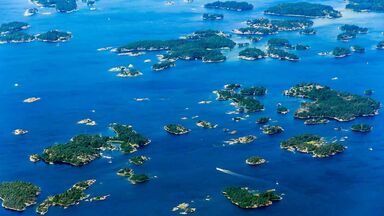
Word History: How did a glacier-covered island get the name Greenland? In Norse legends written in the 12th century and later, it is told that Eric the Red explored the southeast and southwest coasts of Greenland in A.D. 983-986 and gave the country its name because people would be more likely to go there if it had an attractive name. Greenland was warmer in the tenth century than it is now. There were many islands teeming with birds off its western coast; the sea was excellent for fishing; and the coast of Greenland itself had many fjords where anchorage was good. At the head of the fjords there were enormous meadows full of grass, willows, junipers, birch, and wild berries. Thus Greenland actually deserved its name. Another attraction of Greenland was that Iceland and northwestern Europe, including England, had a grievous year of famine in 976, and people were hungry for food as well as land.