Alligator Definition
ălĭ-gātər
alligators
noun
alligators
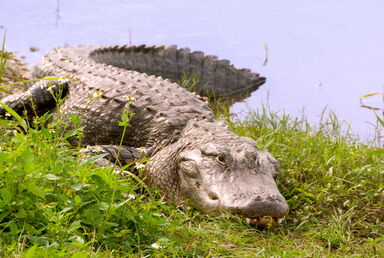
Either of two large semiaquatic reptiles, Alligator mississipiensis of the southeast United States or A. sinensis of China, having sharp teeth and powerful jaws. They differ from crocodiles in having a broader, shorter snout.
American Heritage
Any of a genus (Alligator) of large crocodilian reptiles found in tropical rivers and marshes of the U.S. and China: its snout is shorter and blunter than the crocodile's, and its teeth do not protrude outside its closed mouth.
Webster's New World
Leather made from the hide of one of these reptiles.
American Heritage
A scaly leather made from an alligator's hide.
Webster's New World
A tool or fastener having strong, adjustable, often toothed jaws.
American Heritage
Synonyms:
verb
(of paint or other coatings) To crack in a pattern resembling an alligator's skin.
Wiktionary
pronoun
A taxonomic genus within the family Alligatoridae — the alligators.
Wiktionary
Other Word Forms of Alligator
Noun
Singular:
alligatorPlural:
alligatorsOrigin of Alligator
-
Alteration of Spanish el lagarto the lizard el the (from Latin ille that al-1 in Indo-European roots) lagarto lizard (from Latin lacertus)
From American Heritage Dictionary of the English Language, 5th Edition
-
From Latin alligator (“one who ties or binds”), from alligo (“I bind”) + -tor (“agent suffix”)
From Wiktionary
-
Borrowing from Spanish el lagarto ("the lizard").
From Wiktionary
-
Borrowing from Latin alligātor.
From Wiktionary




Find Similar Words
Find similar words to alligator using the buttons below.