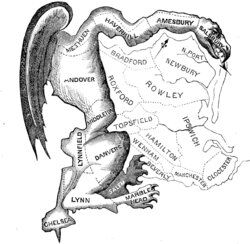
gerrymander

Gerrymander is defined as to divide a voting area to give one political party a majority.

(verb)

An example of gerrymander is to change the geographic boundries of a voting district so that more voters from one political party are included.

The definition of a gerrymander is a changing of voting districts to give one party an advantage or disadvantage a group.

(noun)

An example of a gerrymander is a creation of a smaller voting district to take away votes from a particular candidate.

YourDictionary definition and usage example. Copyright © 2013 by LoveToKnow Corp.

See gerrymander in Webster's New World College Dictionary

transitive verb

  1. to divide (a voting area) so as to give one political party a majority in as many districts as possible or weaken the voting strength of an ethnic or racial group, urban population, etc.
  2. to manipulate unfairly so as to gain advantage

Origin: satirical coinage after Elbridge Gerry, governor of Mass. when the method was employed (1812) + (sala)mander (the shape of the redistricted Essex County)

intransitive verb

to engage in gerrymandering

noun

a redistricting of voting districts to the advantage of one party or disadvantage of a group, region, etc.

See gerrymander in American Heritage Dictionary 4

transitive verb ger·ry·man·dered, ger·ry·man·der·ing, ger·ry·man·ders
To divide (a geographic area) into voting districts so as to give unfair advantage to one party in elections.
noun
  1. The act, process, or an instance of gerrymandering.
  2. A district or configuration of districts differing widely in size or population because of gerrymandering.

Origin:

Origin: After Elbridge Gerry

Origin: + (sala)mander (from the shape of an election district created while Gerry was governor of Massachusetts)

.

Word History: “An official statement of the returns of voters for senators give[s] twenty nine friends of peace, and eleven gerrymanders.” So reported the May 12, 1813, edition of the Massachusetts Spy. A gerrymander sounds like a strange political beast, which it is, considered from a historical perspective. This beast was named by combining the word salamander, “a small lizardlike amphibian,” with the last name of Elbridge Gerry, a former governor of Massachusetts—a state noted for its varied, often colorful political fauna. Gerry (whose name, incidentally, was pronounced with a hard g, though gerrymander is now commonly pronounced with a soft g) was immortalized in this word because an election district created by members of his party in 1812 looked like a salamander. According to one version of gerrymander's coining, the shape of the district attracted the eye of the painter Gilbert Stuart, who noticed it on a map in a newspaper editor's office. Stuart decorated the outline of the district with a head, wings, and claws and then said to the editor, “That will do for a salamander!” “Gerrymander!” came the reply. The word is first recorded in April 1812 in reference to the creature or its caricature, but it soon came to mean not only “the action of shaping a district to gain political advantage” but also “any representative elected from such a district by that method.” Within the same year gerrymander was also recorded as a verb.

Learn more about gerrymander

link/cite print suggestion box