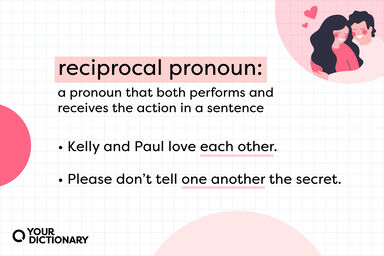
pron. Each the other. Used to indicate that a relationship or an action is reciprocal among the members of the set referred to by the antecedent: The boys like each other.
Usage Note: It is often maintained that
each other should be used to denote a reciprocal relation between two entities, with
one another reserved for more than two: thus
The twins dislike each other but
The triplets dislike one another. Sixty-four percent of Usage Panelists say that they follow this rule in their own writing. But it should be pointed out that many reputable writers from Samuel Johnson onward have ignored the rule and that the use of
each other for more than two, or of
one another for two, cannot be considered incorrect. In particular, there are contexts in which
each other and
one another are subtly different in meaning. When speaking of an ordered series of events or stages,
one another is the preferred form. Thus the sentence
The waiters followed one another into the room was preferred by 73 percent of the Usage Panel to the sentence
The waiters followed each other into the room. •
Each other should not be used as the subject of a clause in writing. Instead of
We always know what each other is thinking, one should write
Each of us knows what the other is thinking. • The possessive forms of
each other and
one another are written
each other's and
one another's: The boys wore each other's (not each others') coats. They had forgotten one another's (not one anothers') names.