amino acid Hear it!

amino acid Definition

amino acid

noun

  1. any of a large group of organic acids containing a carboxyl group, COOH, and an amino group, NH
  2. any of the 25 amino acids that link together into polypeptide chains to form proteins that are necessary for all life: in general, they are water-soluble, crystalline, amphoteric electrolytes having mirror-image isomeric forms with right and left optical activity: ten of these (essential amino acids) cannot be synthesized by the human body and must be consumed

amino acid Usage Examples

Converse of object

  • contain: Contains essential amino acids and over 70 trace elements.
  • conserve: The carbohydrate-binding sites of these lectins consist of two conserved amino acids on beta pleated sheets.
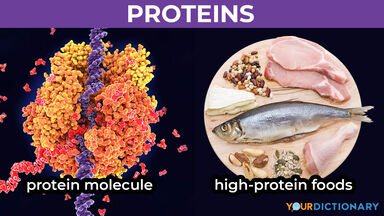
  • call: Proteins are made of long chains of even smaller building blocks called amino acids.
  • convert: Copper also helps convert amino acids into pigment, thereby adding color to hair and skin.
  • specify: Each set of three bases, or codon, specifies a particular amino acid.
  • find: For instance, Taurine is an important amino acid found in high concentrations in mother's milk.

Preposition: in

  • protein: The coding region ( light blue ) is the information used to define the sequence of amino acids in the protein.

Adjective modifier

  • non-essential: The researchers also found that protein synthesis was not enhanced by the addition of non-essential amino acids.
  • essential: This essential amino acid is vital in the make up of critical body proteins.
  • specific: However, the NO boosting power of this specific amino acid is heavily dependent upon the bonded ratio of L-Arginine to AKG.
  • different: Codon degeneracy Although there are 64 possible triplet codons, there are only 20 different amino acids coded by them.
  • particular: Three of the codons are instructions to stop building, which leaves 61 to code for particular amino acids.

Modifies a noun

  • sequence: The components of the upstream module are highly homologous in amino acid sequence to their downstream counterparts.
  • residue: This score is the sum of the weights corresponding to the amino acid residues found in the target sequence at each weight matrix position.
  • substitution: One subunit ( top right ) has been displaced to display the location of the amino acid substitutions ( in cyan and white ).
  • proline: When plants experience a drought, they produce special compounds, such as the amino acid proline.
  • cysteine: Firstly, asparagus contains a number of sulfur containing chemicals including the amino acids cysteine and methionine.
  • phenylalanine: Phenylketonuria is a genetic disorder, which means, from birth, these persons cannot break down the amino acid phenylalanine.

Noun used with modifier

  • branched-chain: These mice provide an important animal model for study of the branched-chain amino acids metabolism and its toxicity.
  • blood: Studies have confirmed that muscle protein synthesis rates are stimulated as long as blood amino acid concentrations remain high [ 12 ] .

Browse dictionary entries near amino acid

  1. amino
  2. amine
  3. Amindivi Islands
  4. amigo
  5. Amiens
  6. amie
  7. amidst
  8. amidships
  9. amidone
  10. amidol
  1. amino-
  2. amino resin
  3. aminobenzoic acid
  4. aminophenol
  5. aminopyrine
  6. aminotriazole
  7. amir
  8. Amis
  9. Amish
  10. amiss