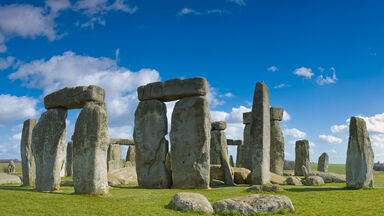
Stones are hard pieces of mineral or earth.
(noun)An example of stones are kidney stones, containing calcium with either oxalate or phosphate.
Stones are pieces of rock that have been smoothed.
(noun)An example of stones are smoothed rocks in a riverbed.
See Stones in Ologies
Stones
a construction consisting of two or more upright stones with a third on top, regarded by archaeologists as an ancient tomb or monument.
a stone tool, as one used in the early Stone Age. —eolithic, adj.
lapidification
the process of turning to stone. Also called petrifaction, petrification.
lithoidolatry
the worship of rocks and stones. — lithoidolater, n. — lithoidolatrous, adj.
lithomancy
a form of divination involving rocks or stones.
macrolith
a tool made of stone, usually about 12 inches long.
a stone of great size, as found in the monuments and constructions of ancient, particularly prehistoric, peoples. — megalithic, adj.
an upright, monumental stone, as a cromlech, standing by itself or in a group or circle with others.
a single large block of stone used in architecture or sculpture. —monolithic, adj.
a stone artifact from the Neolithic (Stone) Age.
a stonelike concretion in the inner ear of some vertebrates, as the whale.
pessomancy
a form of divination involving pebbles. Also called psephology.
lapidification.
petroglyphy
the study of drawings or carvings made on rocks by a member of a prehistoric or primitive people. Also called petrography. —petroglyph, n. —petroglyphic, adj.
sabulosity
the quality or condition of being sandy or gritty, as a stone. —sab-ulous, adj.
Learn more about Stones