Jupiter

The definition of Jupiter is the largest planet in our solar system, or the supreme god in Roman mythology.

Facts About Jupiter

  • Jupiter was named for the Roman king of the gods.
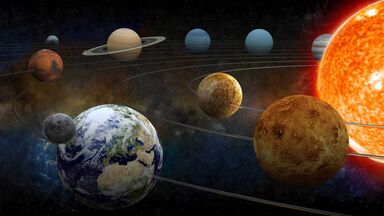
  • Jupiter is the the fifth planet in the solar system and the largest of all the known planets, more than eleven times bigger that Earth.
  • Jupiter contains both atmospheric gases and gases underneath the surface of the planet:
  • Atmospheric Gases - Ammonia and Ammonium Hydrosulfide
  • Gases Underneath the Surface - Helium, Methane, Hydrogen and Ammonium Hydrosulfide
  • It is believed to have a small, rocky core.
  • Jupiter has four faint dust rings which were detected in 1979.
  • It is noted for it’s colorful striations of red, white, yellow, and brown. The light colored areas are called bands while the darker colored areas are called belts.
  • Jupiter has the strongest magnetic field of all of the planets in the solar system.
  • There are very strong electrical currents running through this planet.
  • Jupiter generates its own heat.
  • It has clouds of ammonia crystals. The temperature in the cloud tops of Jupiter is 230 degrees Fahrenheit.
  • Jupiter is five times farther away from the Sun than the Earth. Its average distance from the sun is 483,780,000 miles.
  • Jupiter spins faster than any other planet in our solar system which causes it to bulge in the middle and flatten at the poles. Jupiter rotates in approximately 10 hours.
  • Jupiter has an elliptical orbit around the sun. One orbit is almost 12 Earth years long. It takes Jupiter 12 Earth years to orbit once around the sun.
  • Jupiter’s most noticeable feature is called the Great Red Spot. It is an enormous, violent storm, similar to a hurricane on Earth and measures approximately the same diameter as Earth. Scientists are not completely sure what causes the Great Red Spot.
  • To date, Jupiter has 63 known moons and confirmed satellites, the most of any planet. The moons were only discovered after 1975.
  • Galileo’s observation of Jupiter’s moons was the first known recording of them, and Galileo was the first individual to observe Jupiter using a telescope.
  • Seven different probes have been sent to learn more about Jupiter. The first was Pioneer 10 which did a fly by of Jupiter in 1973. In 1979, Voyager 1 and Voyager 2 discovered Jupiter's rings. The Galileo orbitor, launched in 1989, reached orbit by 1995 and collected data for over seven years until 2003 when it was intentionally crashed into the planet.
(noun)

  1. An example of Jupiter is the fifth planet from the Sun.
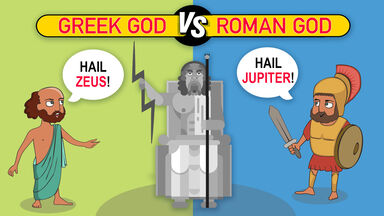
  2. An example of Jupiter is the Greek god Zeus.

YourDictionary definition and usage example. Copyright © 2013 by LoveToKnow Corp.

See Jupiter in Webster's New World College Dictionary

noun

  1. Rom. Myth. the chief deity, god of thunder and the skies: identified with the Greek Zeus
  2. the largest planet of the solar system and the fifth in distance from the sun: it has a ring composed of microscopic dustlike particles: diameter, c. 142,980 km (c. 88,850 mi); period of revolution, 11.86 earth years; period of rotation, 9.92 hours; 62 satellites; symbol, ♃

Origin: L Juppiter, orig. a voc. < bases of Jovis, Jove & pater, father

See Jupiter in American Heritage Dictionary 4

noun
  1. Roman Mythology The supreme god, patron of the Roman state and brother and husband of Juno. He came to be identified with the Greek Zeus. Also called Jove.
  2. Astronomy The fifth planet from the sun, the largest and most massive in the solar system, having a sidereal period of revolution about the sun of 11.86 years at a mean distance of 778 million kilometers (483 million miles), a mean diameter of approximately 142,000 kilometers (88,000 miles), and a mass approximately 318 times that of Earth.

Origin:

Origin: Latin Iūpiter; see dyeu- in Indo-European roots

.

Learn more about Jupiter

Related Articles

Jupiter

link/cite print suggestion box