Islam

Islam is the Muslim religion, the group of people who practice the Muslim religion, or the areas where the Muslim religion is the dominate religion practiced.

(noun)

  1. An example of Islam is the religion based on the Qur'an.
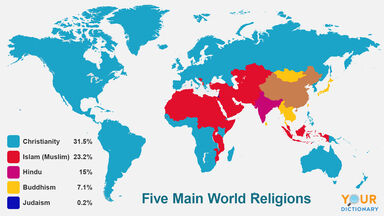
  2. An example of Islam is Indonesia.

YourDictionary definition and usage example. Copyright © 2013 by LoveToKnow Corp.

See Islam in Webster's New World College Dictionary

noun

  1. the Muslim religion, a monotheistic religion in which the supreme deity is Allah and the chief prophet and founder is Mohammed
  2. Muslims collectively
  3. all the lands in which the Muslim religion predominates

Origin: Ar islām, lit., submission (to God's will) < salama, to be resigned

Related Forms:

See Islam in American Heritage Dictionary 4

noun
  1. A monotheistic religion characterized by the acceptance of the doctrine of submission to God and to Muhammad as the chief and last prophet of God.
  2. a. The people or nations that practice Islam; the Muslim world.
    b. The civilization developed by the Muslim world.

Origin:

Origin: Arabic ’islām, submission

Origin: , from ’aslama, to surrender, resign oneself

Origin: , from Syriac ’ašlem, to make peace, surrender

Origin: , derived stem of šlem, to be complete; see šlm in Semitic roots

.

Related Forms:

  • Is·lamˈic adjective

See Islam in Ologies

Islam

See also faith; god and gods; religion; theology.

Alcoranist

a strict follower of the Koran.

Babism

the doctrines and practices of a 19th-century Persian sect that formed the basis for the current Baha’i organization, regarded as heretical by orthodox Muslims because its leader proclaimed himself to be the Imam Mahdi, the expected twelfth Imam of the Shiite sect, who would establish justice on earth. —Babist, n.

Ghazism

the activities of the Ghazis, fanatics sworn to destroy all infidels.

Imamite

a member of the Shi’a sect of Muslims, who believe in a succession of twelve divinely inspired imams, from Ali to Muhamad al Muntazar.

Islam, Islamism

the religion of Islam; Muhammadanism. —Islamist, n. —Islamitic, adj.

Kaabism

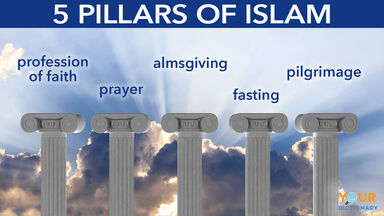
the tradition in Islam of venerating a shrine in Mecca through pilgrimage and prayers made after turning in its direction. —Kaaba, n., adj.

Karmathian

an adherent of a heretical 9th-century Muslim sect that considers the Koran as mere allegory and is opposed to prayer, fasting, and revelation.

Mahdism

the belief in Mahdi, the Muslim spiritual guide who, on Judgment Day, will lead the faithful to salvation. —Mahdist, n.

Muhammadanism, Mohammedanism

the doctrines and practices of the religion founded by the prophet Muhammad and set forth in the Koran. Also called Islam, Islamism. —Muhammadan, Mohammedan, n.

Pan-Islamism

the doctrines of Sultan Abdul-Hamid’s 19th-century political movement that was against the westernization and unification of Islam. —Pan-Islamist, n. —Pan-Islamic, adj.

Senusism, Sanusism

a 19th-century Islamic brotherhood observing a strict and ascetic religious orthodoxy and practicing militant political activity. Also Senusiya, Sanusiya. —Senusi, Sanusi, n.

Shiism

the doctrines and practices of Shi’a, one of the two major branches of Islam, regarding Ali, the son-in-law of Muhammad, as the Prophet’s legitimate successor. See also Sunnism. —Shiite, n., adj.

Sufism

the beliefs and practices of an ascetic, retiring, and mystical sect in Islam. —Sufi, n., adj.

Sunnism

the doctrines and practices of the larger of the two major branches of Islam, regarding as legitimate the first four caliphs after Muhammad’s death and stressing the importance of the traditional portion of Muslim law (the Sunna). See also Shiism. — Sunnite, n., adj.

talismanist

Obsolete, a Muslim holy man.

Learn more about Islam

Islam

link/cite print suggestion box