extrapolate
extrapolate
Definition
ex·trapo·late (ek strap′ə lāt′, ik-)
transitive verb, intransitive verb extrapolated -·lat′ed, extrapolating -·lat′·ing
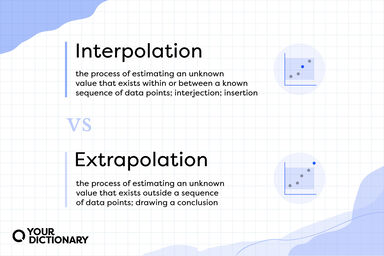
- Statistics to estimate or infer (a value, quantity, etc. beyond the known range) on the basis of certain variables within the known range, from which the estimated value is assumed to follow
- to arrive at (conclusions or results) by hypothesizing from known facts or observations
- to speculate as to consequences on the basis of (known facts or observations)
Etymology: L extra (see extra-) + (inter)polate
Related Forms:
- extrapolation ex·trap′o·la′·tion noun
- extrapolative ex·trap′o·la′·tive adjective
- extrapolator ex·trap′o·la′·tor noun
extrapolate
Usage Examples
Object
- finding: It makes even less sense to extrapolate findings in young monkeys to old women.
- trend: It is dangerous to extrapolate these trends to the UK, however.
- figure: If we extrapolate these figures to Britain, some 111,000 people would have died, with 1.4 million people injured.
- result: To extrapolate the survey result to the public in general could be unwise, " he added.
- datum: Having drawn your graph, extrapolate the data for the next three months.
Used with why or when
- what: That's because standard toxicology tests use much higher doses to quickly but roughly extrapolate what happens in the real world.
Modifying Another Word
- simply: Argument of extremes The argument of extremes simply extrapolates each side of the argument to the point where they become unreal.
- directly: Of course you can't extrapolate directly from a chicken to a man.
Preposition: from
- experiment: It is not possible to extrapolate from animal experiments to human studies.
- experience: We extrapolate from recent experience into the unknown, often coming to quite incorrect conclusions.
Browse dictionary entries near extrapolate