Enzyme Definition
ĕnzīm
enzymes
noun
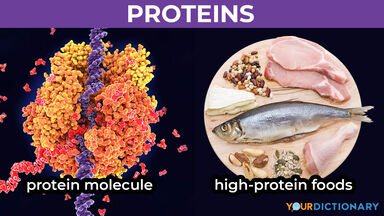
Any of various proteins, formed in plant and animal cells or made synthetically, that act as organic catalysts in initiating or speeding up specific chemical reactions and that usually become inactive or unstable above c. 50°C (122°F)
Webster's New World
Any of numerous compounds that are produced by living organisms and function as biochemical catalysts. Some enzymes are simple proteins, and others consist of a protein linked to one or more nonprotein groups.
American Heritage
(biochemistry) A globular protein that catalyses a biological chemical reaction.
Wiktionary
Synonyms:
- saccharase
- ribonuclease
- lipoxidase
- insulinase
- holoenzyme
- esterase
- digestant
- deoxyribonuclease
- coenzyme
- carbohydrase
- beta-amylase
- pepsin
- renin
- protease
- protein
Other Word Forms of Enzyme
Noun
Singular:
enzymePlural:
enzymesOrigin of Enzyme
-
German Enzym from Medieval Greek enzūmos leavened Greek en- in en–2 Greek zūmē leaven, yeast
From American Heritage Dictionary of the English Language, 5th Edition
-
German Enzym from Medieval Greek enzūmos leavened Greek en- in en–2 Greek zūmē leaven, yeast
From American Heritage Dictionary of the English Language, 5th Edition
-
From German Enzym, created in 1878, by the German physiologist Wilhelm Kühne from Ancient Greek ἐν (en, “in”) and ζύμη (zýmē, “sourdough”).
From Wiktionary



Find Similar Words
Find similar words to enzyme using the buttons below.