D-day Definition
D·-day (dē′dā′)
noun
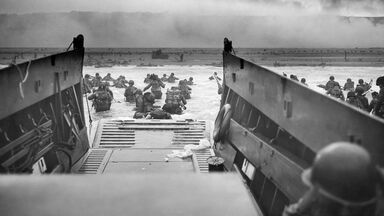
the day on which a military attack or other important event is to take place; specif., June 6, 1944, the day of the invasion of W Europe by Allied forces in WWII
Etymology: D, the first letter of day
D-day Usage Examples
Converse of object
- include: Epic battlefield moments including D-Day, the Russian charge at Stalingrad and the battle for Berlin.
- follow: Killed in the fighting around Caen following D-Day on 22nd of July 1944, aged 25.
- remember: Remembering D-Day: Personal Histories of Everyday Heroes Martin Bowman, published by HarperCollins.
- have: Where shooters have D-Day, flight sims have Pearl Harbor.
- announce: So I was up in Woolworths in Blackpool listening to the news when they announced D-Day.
- miss: I missed D-Day, safely out of harm's way in the Far East!
Modifies a noun
- landing: The D-Day landings were the turning point of the Second World War.
- commemoration: Richard implemented a change to the upgraded server, at about the time of the D-Day commemoration in June.
- invasion: In more recent times the area had a large part to play in the D-Day invasion of June 1944.
- veteran: We are highly organized, with many returning D-Day veterans.
- beach: When he led a unit on to the D-Day beaches, they had been hit by friendly fire and American planes killed his comrades.
- celebration: Or perhaps you can help in regard to the 60th D-Day celebrations.
Noun used with modifier
- anniversary: These critics particularly enjoy trotting out the example of 1994's 50th anniversary D-Day celebrations.
- pre: This unit will be used in the pre d-day invasion landings.
Browse dictionary entries near D-day
- ‹ D/D
- ‹ D channel
- ‹ d/b/a
- ‹ D'Avenant
- ‹ d'Arc
- ‹ d'Arblay
- ‹ d'Annunzio
- ‹ D'Anjou pear
- ‹ D and C
- ‹ D-AMPS
- débouché ›
- débrouillard ›
- déclassé ›
- décolleté ›
- décolletage ›
- décor ›
- dégagé ›
- déjà vu ›
- déjeuner ›
- démarche ›