colon

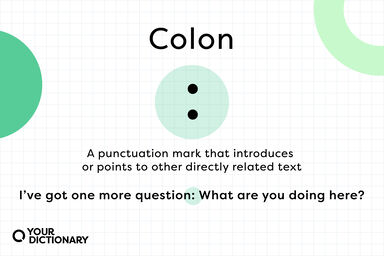
The definition of a colon is a punctuation mark (:) used to shows that what follows is an explanation such as a quotation, example or list and as a mark used between numbers to show time and ratios, or the last part of the digestive system, or part of a poem that forms a rhythmic unit.

(noun)

  1. An example of a colon is the : in 5:30 a.m.
  2. An example of a colon is a part of the large intestine from the cecum to the rectum that can get diseased with cancer.
  3. An example of a colon is a type of section in a Greek poem.

YourDictionary definition and usage example. Copyright © 2013 by LoveToKnow Corp.

See colon in Webster's New World College Dictionary

noun

  1. a mark of punctuation (:) used before an extended quotation, explanation, example, series, etc. and after the salutation of a formal letter
  2. pl. cola in Greek prosody, a section of a prosodic period, consisting of a group of two to six feet forming a rhythmic unit with a principal accent

Origin: L < Gr kōlon, part of a verse, member, limb < IE base *(s)kel-, to bend, crooked > L coluber, snake, calx, heel

noun pl. colons or cola

that part of the large intestine extending from the cecum to the rectum

Origin: L < Gr kolon

Related Forms:

noun

a colonist, esp. one who owns a plantation

Origin: Fr

See colon in American Heritage Dictionary 4

noun pl. co·lons
  1. a. A punctuation mark ( : ) used after a word introducing a quotation, an explanation, an example, or a series and often after the salutation of a business letter.
    b. The sign ( : ) used between numbers or groups of numbers in expressions of time (2:30 A.M.) and ratios (1:2).
  2. pl. co·la (-lə) A section of a metrical period in quantitative verse, consisting of two to six feet and in Latin verse having one principal accent.

Origin:

Origin: Latin cōlon, part of a verse

Origin: , from Greek kōlon, limb, member, metrical unit

.

noun pl. co·lons or co·la (-lə)
The section of the large intestine extending from the cecum to the rectum.

Origin:

Origin: Middle English

Origin: , from Latin

Origin: , from Greek kolon, large intestine

.

Related Forms:

  • co·lonˈic (kə-lŏnˈĭk) adjective

noun pl. co·lons or co·lo·nes (-lōˈnāsˌ)
See Table at currency.

Origin:

Origin: Spanish colón

Origin: , after Cristóbal Colón, Christopher Columbus

.

A city of northern Panama at the Caribbean entrance to the Panama Canal. The city was founded as Aspinwall in 1850 by Americans working on the Panama Railroad and was renamed in 1890. Population: 76,600.

Learn more about colon

Related Articles

link/cite print suggestion box