buffalo

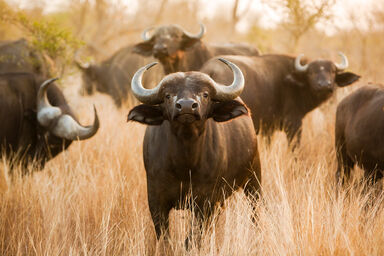
The definition of a buffalo is a large wild ox with horns that point to the back.

(noun)

An example of a buffalo is the water buffalo.

To buffalo is to confuse or deceive.

(verb)

An example of buffalo is to convince someone to get a loan with a very high interest rate by suggesting that the interest rate will be low.

YourDictionary definition and usage example. Copyright © 2013 by LoveToKnow Corp.

See buffalo in Webster's New World College Dictionary

noun pl. buffaloes, buffalo, buffalos

  1. any of various wild oxen, sometimes domesticated, as the water buffalo of India or Cape buffalo of Africa
  2. popularly the American bison
  3. ☆ a robe made of buffalo skin
  4. ☆ buffalo fish

Origin: It bufalo < LL bufalus, var. of bubalus, wild ox < Gr boubalos, buffalo, antelope < bous, ox, cow

transitive verb buffaloed, buffaloing

Slang to baffle, bewilder, bluff, or overawe

city in W N.Y., on Lake Erie & the Niagara River: pop. 293,000

Origin: transl. of the name of a Seneca Indian who lived there

See buffalo in American Heritage Dictionary 4

noun pl. buffalo buffalo or buf·fa·loes or buf·fa·los
  1. a. Any of several oxlike Old World mammals of the family Bovidae, such as the water buffalo and African buffalo.
    b. The North American bison, Bison bison.
  2. The buffalo fish.
transitive verb buf·fa·loed, buf·fa·lo·ing, buf·fa·loes
  1. To intimidate, as by a display of confidence or authority: “The board couldn't buffalo the federal courts as it had the Comptroller” (American Banker).
  2. To deceive; hoodwink: “Too often . . . job seekers have buffaloed lenders as to their competency and training” (H. Jane Lehman).
  3. To confuse; bewilder.

Origin:

Origin: Italian bufalo

Origin: or Portuguese

Origin: or Spanish búfalo

Origin: , from Late Latin būfalus

Origin: , from Latin būbalus, antelope, buffalo

Origin: , from Greek boubalos

Origin: , perhaps from bous, cow; see gwou- in Indo-European roots

.

Word History: The buffalo is so closely associated with the Wild West that one might assume that its name comes from a Native American word, as is the case with the words moose and skunk. In fact, however, buffalo can probably be traced back by way of one or more of the Romance languages through Late and Classical Latin and ultimately to the Greek word boubalos, meaning “an antelope or a buffalo.” The buffalo referred to by the Greek and Latin words was of course not the American one but an Old World mammal, such as the water buffalo of southern Asia. Applied to the North American mammal, buffalo is a misnomer, bison being the preferred term. As far as everyday usage is concerned, however, buffalo, first recorded for the American mammal in 1635, is older than bison, first recorded in 1774.

A city of western New York at the eastern end of Lake Erie on the Canadian border. It is a major Great Lakes port of entry and an important manufacturing and milling center. Population: 276,000.

Related Forms:

  • Bufˌfa·loˈni·an adjective & n.

Learn more about buffalo

buffalo

link/cite print suggestion box