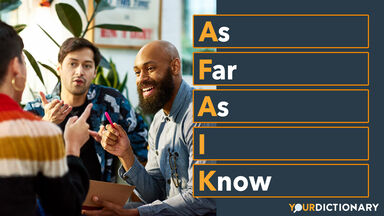
conjunction To the degree or extent that: They returned at nine, as far as we know.
Usage Note: As far as the Usage Panel is concerned,
as far as had better be followed by both a subject and a form of
go or
be concerned. As far as is sometimes used as a preposition meaning “as for” or “regarding,” especially in speech, but a large majority of the Panel frowns upon this usage. Eighty percent find the
as far as construction in this sentence unacceptable:
As far as something to do on the weekend, we didn't even have miniature golf. Eighty-four percent reject the sentence
The Yankees are still very much alive, as far as the divisional race. Further, 89 percent object to
as far as when followed by a noun clause, as in
As far as how Koresh got shot, we don't know yet.Our Living Language Despite the admonitions detailed in the Usage Note, recent research indicates that speakers of English in the United States and elsewhere are increasingly dropping the verbal part of the
as far as construction, as in
As far as a better house, I don't want one (instead of
As far as a better house is concerned …). This trend is more noticeable in speech than in writing. We can infer that this syntactic change is ongoing because teenagers and young adults omit
is/are concerned and
go/went in these constructions more often than older speakers do. • Like other examples of language variation and change, a number of constraints that we follow regularly, although unconsciously, govern the dropping of the verb in
as far as constructions. For instance, if
as far as precedes a personal pronoun or one whose point of view is being represented (
as far as he is concerned), the verb cannot be deleted (notice that
as far as he is strikingly ungrammatical). The longer and more complex the noun or sentence that follows
as far as, the more likely the verb is to be omitted. Thus,
As far as getting a better house to live in, we … is more likely to be uttered than
As far as a house, we᠁ The very similar phrase
so far as is found within verbless constructions in complex sentences that use gerunds as early as the 19th century, as in Jane Austen's novel
Emma: “so far as our living with Mr. Churchill at Enscombe, it is settled.” These omissions in longer constructions seem to have initiated the change leading to their omission in short locutions. Only in the 20th century do we find first noun phrases and then simple nouns without a form of
go or
be concerned.