An Definition
ən; ăn when stressed
article
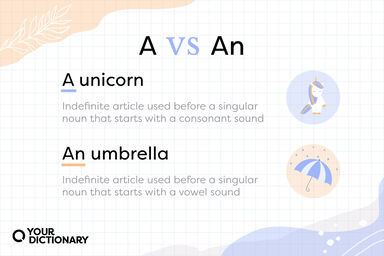
The form of a used before words beginning with a vowel sound.
An elephant; an hour; an umbrella.
American Heritage
conjuntion
And if; if.
American Heritage
And.
Webster's New World
If.
Webster's New World
abbreviation
Airman, Navy.
American Heritage
In the year.
Webster's New World
Anno (in the year)
American Heritage
Ante (before)
American Heritage
suffix
Of, relating to, or resembling.
Brachyuran.
American Heritage
One relating to, belonging to, or resembling.
Librarian.
American Heritage
Unsaturated carbon compound.
Furan.
American Heritage
Anhydride of a carbohydrate.
Dextran.
American Heritage
adjective
One; one sort of.
To bake an apple pie.
Webster's New World
Any one.
Pick an apple from the tree.
Webster's New World
preposition
To each; in each; for each; per.
Two an hour.
Webster's New World
affix
Webster's New World
Webster's New World
(one) Belonging to or having some relation to.
Diocesan.
Webster's New World
(one) Born in or living in.
Mexican.
Webster's New World
(one) Believing in or following.
Lutheran.
Webster's New World
symbol
contraction
She'll be ridin' an' comin' up soon. The smart girl an' the silly boy.
Wiktionary
Origin of An
-
Middle English from Old English ān one oi-no- in Indo-European roots
From American Heritage Dictionary of the English Language, 5th Edition
Middle English from Old French from Latin -ānus adj. and n. suff
From American Heritage Dictionary of the English Language, 5th Edition
-
Middle English short for and and from Old English and
From American Heritage Dictionary of the English Language, 5th Edition
Fr -ain, -en < L -anus, of, belonging to; also directly < L
From Webster's New World College Dictionary, 5th Edition
Alteration of –ane
From American Heritage Dictionary of the English Language, 5th Edition