infinitive Hear it!

infinitive Definition

in·fini·tive (in fini tiv)

adjective

Gram. of or connected with an infinitive an infinitive phrase

Etymology: LL infinitivus < L infinitivus (modus), lit., unlimited (mood) < infinitus (see infinite): so named because it is not limited to any person, number, or tense

noun

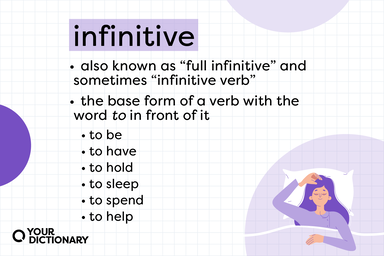
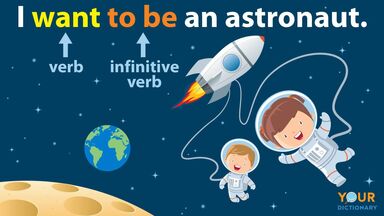
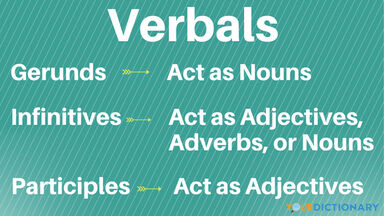
Gram. the form of the verb that expresses existence or action without reference to person, number, or tense and can also function as a noun: in English, it is usually the form of the the first person singular present preceded by the marker to (Ex.: to go, to think) or by another verb form (Ex.: can he speak? make him try)

infinitive Related Forms
in·fin′i·ti·val (-tīvəl) adjective
infinitive Usage Examples

Preposition: of

  • verb: What is noteworthy about the infinitive of this verb?

Converse of object

  • split: Do you need an ax to split an infinitive?
  • use: Avoid using split infinitives - they are widely considered to be poor style.
  • have: All verbs have an infinitive or root, ( to come, to sell ), from which all variations spring.
  • include: Non-finite verb forms include infinitives and participles, plus some derived adjectives.
  • find: There were no infinitives in the passage above, but see if you can find the infinitives in the following excerpt.

Adjective modifier

  • splitting: It is hilarious that an invented prohibition of splitting infinitives should have such an impact even today without people even knowing why.
  • English: It does not follow the same rules as the English infinitive.

Modifies a noun

  • verb: Modals are followed by the infinitive verb form, e.g. They must leave.
  • clause: After the aorist infinitive clause " Before Abraham was " , properly the perfect clause and tense should follow but does not.
  • construction: The liability to maintain is the obligation or duty to maintain: an infinitive construction - liability to do something.
  • form: Word order All of these modal verbs need to be used with a second verb in the infinitive form.
  • ending: VERBS will be listed in the 1st Person sing. of the Present Tense, followed by the Present Infinitive ending, e.g.

Noun used with modifier

  • split: Now, who can explain the split infinitive to us?
  • verb: The verb infinitive appears in large print at the right or left corner of the page along with the English translation.
  • non-complement: Most non-complement infinitives are purpose infinitives, but we do not further distinguish types.
  • aorist: After the aorist infinitive clause " Before Abraham was " , properly the perfect clause and tense should follow but does not.
infinitive Quotes

Would you convey my compliments to the purist who reads your proofs and tell him or her that I write in a sort of broken-downpatoiswhichissomething likethewaya Swiss waiter talks, and that when I split an infinitive,God damn it, I split it so it will stay split.

—Chandler, Raymond

Word has somehow got around that the split infinitive is always wrong.That is of a piece with the outworn notion that it is always wrong to strike a lady.

—Thurber,James Grover