(zo͞os)
noun Greek Mythology The principal god of the Greek pantheon, ruler of the heavens, and father of other gods and mortal heroes.
Word History: Homer's
Iliad calls him “
Zeus who thunders on high” and Milton's
Paradise Lost, “
the Thunderer,” so it is surprising to learn that the Indo-European ancestor of Zeus was a god of the bright daytime sky.
Zeus is a somewhat unusual noun in Greek, having both a stem
Zēn- (as in the philosopher
Zeno's name) and a stem
Di- (earlier
Diw-). In the
Iliad prayers to Zeus begin with the vocative form
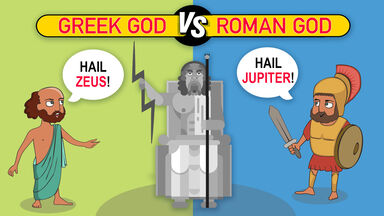
Zeu pater, “o father Zeus.” Father Zeus was the head of the Greek pantheon; another ancient Indo-European society, the Romans, called the head of their pantheon
Iūpiter or
Iuppiter—Jupiter. The
-piter part of his name is just a reduced form of
pater, “father,” and
Iū- corresponds to the
Zeu in Greek:
Iūpiter is therefore precisely equivalent to
Zeu pater and could be translated “father Jove.”
Jove itself is from Latin
Iov-, the stem form of
Iūpiter, an older version of which in Latin was
Diov-, showing that the word once had a
d as in Greek
Diw-. An exact parallel to Zeus and Jupiter is found in the Sanskrit god addressed as
Dyauṣ pitar: pitar is “father,” and
dyauṣ means “sky.” We can equate Greek
Zeu pater, Latin
Iū-piter, and Sanskrit
dyauṣ pitar and reconstruct an Indo-European deity,
*Dyēus pəter, who was associated with the sky and addressed as “father.” Comparative philology has revealed that the “sky” word refers specifically to the bright daytime sky, as it is derived from the root meaning “to shine.” This root also shows up in Latin
diēs “day,” borrowed into English in words like
diurnal. • Closely related to these words is Indo-European
*deiwos “god,” which shows up, among other places, in the name of the Old English god
Tīw in Modern English
Tuesday, “Tiw's day.”
*Deiwos is also the source of Latin
dīvus “pertaining to the gods,” whence English
divine and the Italian operatic
diva, and
deus, “god,” whence
deity.